
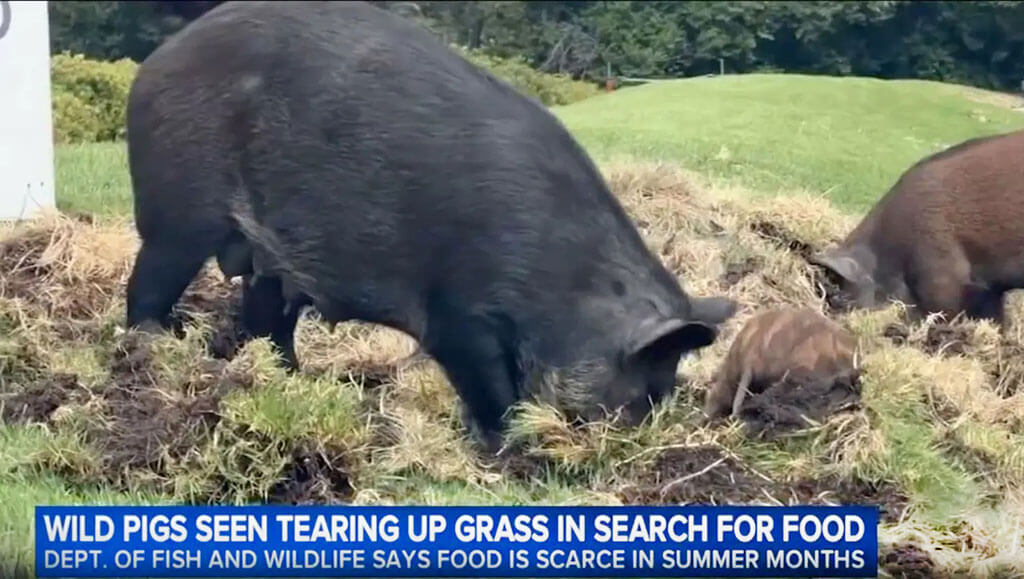
It’s a story that’s been repeated many times in communities across Texas, California, Florida and other states: Residents upset about damage to lawns and landscaping from wild pigs who emerge from nearby wooded areas at night in search of food before disappearing by daylight. Unfortunately, the stories often repeat inaccuracies about wild pigs, exaggerate dangers, and present killing as the only option for homeowners.
There are humane ways to prevent problems with wild pigs. Learning to coexist with wild pigs and other wildlife is always a better option than trapping and killing.
About Wild Pigs in Residential Areas
Wild pigs are not aggressive by nature, and if you take basic precautions (never feed or harass wild pigs, keep dogs on a leash), pigs are not a threat to children or family pets. Most often, wild pigs will run away if approached. But like many wild animals, they are protective of their young and will defend themselves if threatened (pigs sometimes charge as a warning). Attacks are extremely rare. And contrary to popular belief, wild pigs do not carry diseases that are easily transmissible to people.
Wild pigs dig up lawns in search of grubs, worms, plant roots or other food (pigs are not eating the grass). Well-watered lawns are especially attractive to pigs.
Damage may only occur seasonally. Pig activity in residential areas increases during the driest months of the year when food and water in their natural habitat become harder to find.
Who can homeowner’s turn to for help? Local animal services and state wildlife agencies are usually unable or unwilling to help. Often the only advice given to homeowners and HOAs is to hire a private trapper.
Trapping is a death sentence for pigs, despite what a trapper may say. Trapped pigs may leave your property alive, but the animals will end up at a hunting preserve or slaughter facility. It is not legal in any state to release trapped pigs into a natural area.
Trapping is not a long-term solution to human-wildlife conflicts. Without other changes, trapping becomes an expensive, recurring cycle of trap and kill, trap and kill.
There are a number of preventative steps that homeowners can take that may not solve today’s pig problems but will reduce the chances of a repeat visit.
What You Can Do
Remove what attracts wild pigs. Pigs are drawn to residential areas by easy access to food and/or water. Eliminating food and water is the most effective way to avoid damage.
- Treat your lawn for grubs (grub worms are sought-after by wild pigs as well as by birds, moles, and raccoons). There are many products available to kill or prevent grubs.
- Reduce the size of your lawn, replace grass with alternative groundcover, change your flowerbed into a rock garden, or make other landscaping changes so your property is less appealing to pigs.
- Collect fallen fruit and spilled bird seed, rake-up acorns (if you have oak trees). Pet food left outside can also attract pigs and other wildlife.
- Remove or fence off ponds or other water features that may attract pigs, especially during dry periods. Fix drainage problems or areas where water pools after rain.
- Limit overwatering. Pigs prefer moist soil that is easy to dig in and likely to contain food.
- Change your watering schedule. When you water your lawn can also be important. Landscape professionals recommend watering in the morning to reduce water loss due to evaporation. Morning watering also gives the soil time to dry before the overnight hours when pigs are most active.
Block access. Fencing (electric, wire mesh or panel fencing) can stop pigs from entering properties.
- Pigs usually enter residential areas from forests or other green spaces, or by using stream beds or road margins. A physical barrier of these travel corridors could encourage pigs to move on. In Barcelona, Spain, to discourage wild pigs from traveling from natural areas into the city, local authorities cleared vegetation in corridors connecting the two areas (pigs prefer dense vegetation as cover).
Deterrents. Motion-activated lights or sprinklers have been recommended as deterrents but may only work temporarily. Wild pigs become nocturnal to avoid humans, and forage for food at night. Lights can disrupt this activity. Products such as Wild Hog Scram, an “all-natural granular repellent,” have had mixed reviews.
As a final word, experts recommend a coordinated community approach to conflicts with wild pigs. The above strategies are more likely to be successful if homeowners act together to make the entire neighborhood less welcoming to pigs. Protecting only one property will likely not work if food and water is easily available at your neighbor’s house.