
History of Introduction
The first nonnative animal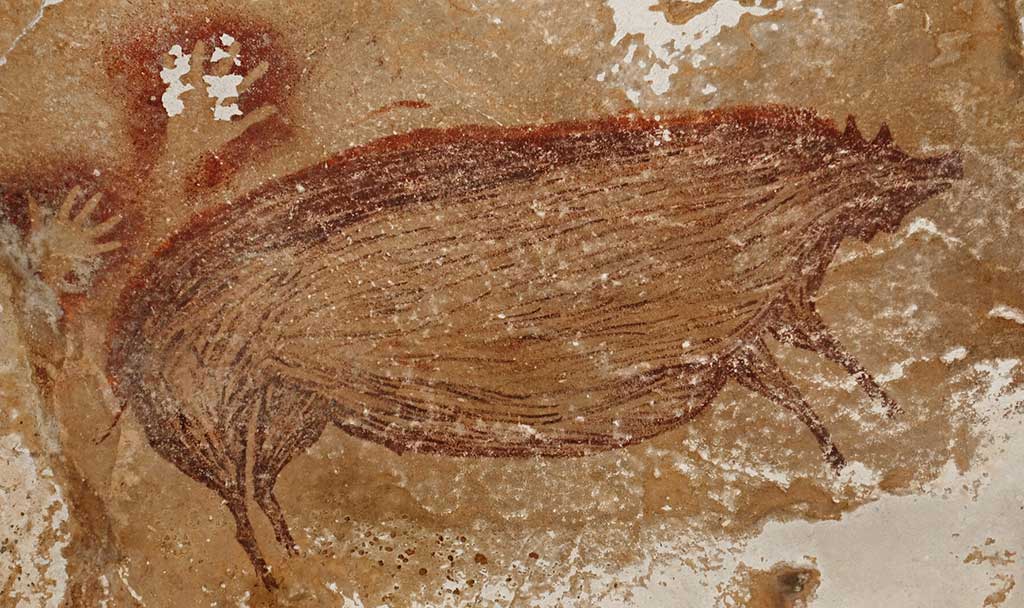
Pigs are depicted in the world’s oldest known cave paintings, dating back at least 50,000 years, on the Indonesian island of Sulawesi.3
Wild pigs were first domesticated 9,000 years ago in Europe and Asia, and for thousands of years humans have been disseminating pigs throughout the world.
The bones of pigs, along with chicken bones and pottery, are used as archeological evidence of human expansion (e.g., human migration from Taiwan to the Philippines in 3,000 BCE).1
Pigs may have been the first mammal to have been intentionally introduced, as early explorers released the animals to roam freely in new lands.2 It is possible that pigs were also one of the first “feral” animals, those that were once domesticated but now live in a wild state.
The wild pig has cultural significance in societies around the world, and throughout history. Pigs feature in the culture, if not the diet, of ancient Egyptians. Restrictions on consumption of the flesh of pigs existed in Egypt and also appear in the religious texts of major world religions. There are stories of pig hunts in Greek mythology (Hercules subduing a wild boar with his bare hands, for example). Wild pigs appear several times in the fables attributed to the Greek storyteller Aesop. There is a 1,000-year-old story from Welsh folklore of King Arthur hunting a wild pig. In Norse mythology, the god Freyr was accompanied by a wild pig called Gullinbursti who had luminescent, golden hair. (Learn more about these and other stories at www.culturalboar.com.)
Pigs arrived in what is now the United States as early as 1000 CE, when Polynesians settled the Hawaiian Islands. Although European explorer Captain James Cook is believed to also have introduced pigs to the islands when he arrived in 1778, DNA studies have shown that today’s wild pigs in Hawaii are descendants of those brought to the islands during Polynesian settlement.4 It took until the 16th century when explorers and sailors from Europe began to travel the world (Age of Exploration) for pigs to reach the continental United States.
When Christopher Columbus set sail in 1493 on his second voyage to the Caribbean, his ships carried eight pigs, as well as horses, cows, and sheep.5 Descendants of pigs from this and Columbus’ later voyages roamed wild in Hispaniola, Jamaica, and Cuba and supported future voyages.
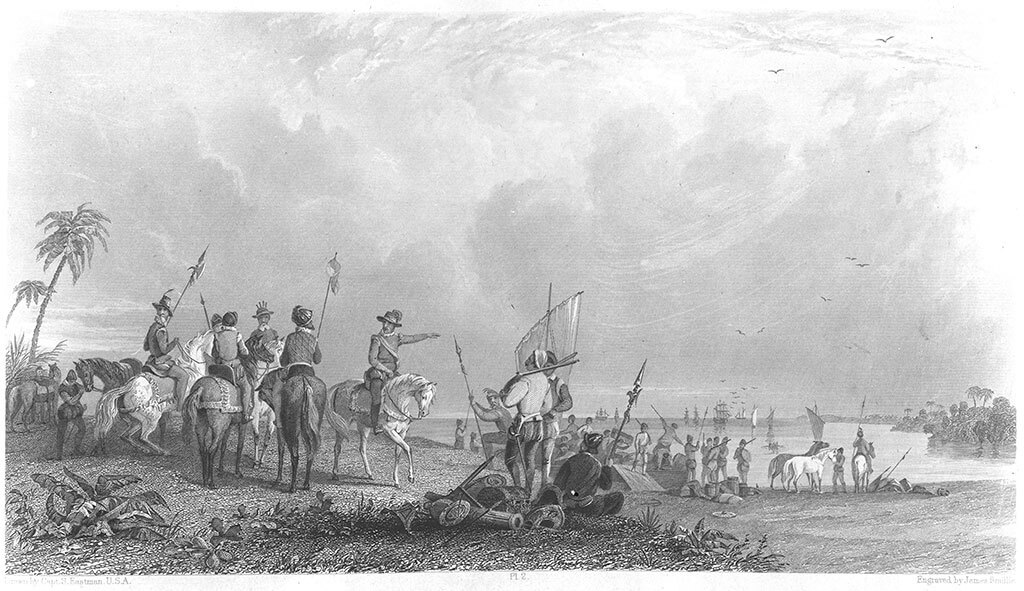
“De Soto Expedition landing at Tampa Bay, Florida, 1539,” drawing by Seth Eastman
Spanish explorer Hernando de Soto, hundreds of men and a fleet of ships left Spain in April 1538, arriving first in Cuba where they found cows and pigs living free. Before leaving Havana for Florida in May 1539, De Soto’s expedition was supplied with horses, dogs and pigs (a total of 13 pigs, by one contemporaneous account).6 They landed on the west coast of Florida. One year later, their herd of pigs had grown to 300.
De Soto’s expedition continued traveling, with droves of pigs as a food supply for soldiers and to serve as seed stock to establish settlements, throughout the southeast, as far north as North Carolina, then west into Texas. Some of the pigs escaped into the wild; others were taken by Indigenous peoples. De Soto died in 1542, in what is now Arkansas, three years after first landing. At the time of his death, according to a firsthand account, De Soto’s herd of pigs numbered 700.6
It is not known if pigs from De Soto’s voyage successfully established free-ranging populations, but other introductions followed. For example, Pedro Menéndez de Avilés, a Spanish explorer who is known for founding the city of St. Augustine, arrived in Florida in 1565 with ships carrying 400 pigs, in addition to sheep and horses.7 One year later, pigs (among other supplies) from St. Augustine were used to establish a new settlement in present-day South Carolina.8
The history of wild pigs in America is a story of many introductions, in many locations. Some pigs who escaped captivity or were released perished, but others survived and created self-sustaining populations.
Pigs quite literally “fueled colonial conquest,” in the words of anthropologists Jason Cons and Michael Eilenberg.9 (Equally important as pig flesh was pig fat for cooking oil, and to make soap, candles, etc.10) Spanish explorers also brought pigs with them during their conquest of Mexico. In 1540, an expedition led by Francisco Vázquez de Coronado traveled north from Mexico as far as present-day Kansas.7
The French introduced pigs to Texas and the Gulf states. French explorer La Salle (René-Robert Cavelier) brought pigs along on his doomed 1685 expedition into Texas.11 A settlement established by La Salle on the Texas coast maintained a large population of free-ranging pigs. This population is often pointed to as important ancestors of the pigs that thrive in south Texas today.
Pierre Le Moyne d’Iberville explored the Louisiana coast in search of the mouth of the Mississippi River and constructed a fort in present-day Mississippi in 1699. A chronicle of the expedition reported that the fort was stocked with cows, chickens and pigs purchased in Hispaniola.12 For many years after the fort was abandoned, there were reports of wild pigs in the area.
Like travelers who came before them, when the first English settlers arrived in North America in the early 1600s, they arrived with livestock, including pigs.
According to historical records, the Jamestown Settlement in present-day Virginia counted over 500 pigs only two years after ships arrived in 1607.7 Colonists released pigs to forage for themselves in the vast forests that once covered the area. Despite predators like wolves and bears, and hunting by Indigenous peoples, the pig population grew quickly. Robert Beverley,13 in his history of Virginia that was published in 1705, wrote about the settlement, “Hogs swarm like Vermine upon the Earth…. The Hogs run where they list, and find their own Support in the Woods, without any Care of the Owner.” In 1702, Francis Louis Michel,14 a Swiss visitor to coastal Virginia, declared that, “Pigs are found there in such numbers that I was astonished.”
Free Range
In early America, it was common for pigs and other livestock to “free range.” Animals were turned loose to fend for themselves, surviving predators, eating what they could find, and were rounded up when needed. Sometimes ear notches or other marks were used to identify owners of animals.
Initially, “Fences were not for keeping livestock penned in, but for keeping livestock out” of small patches of crops, wrote historian Alfred W. Crosby.15
Open range became less of an option as towns grew and forests were cleared, especially in the northeast. But free-range or open-range husbandry practices were still legal and common with pigs in some parts of the country into the mid-20th century. In Louisiana, the free ranging of pigs was only prohibited statewide in 2010.16
It is easy to imagine how the open range contributed to America’s wild pig population. Many pigs likely escaped farmer’s efforts to collect them when the time for sale and slaughter arrived. Wild pigs, through necessity, became excellent survivors in the forests and plains of early America.
“
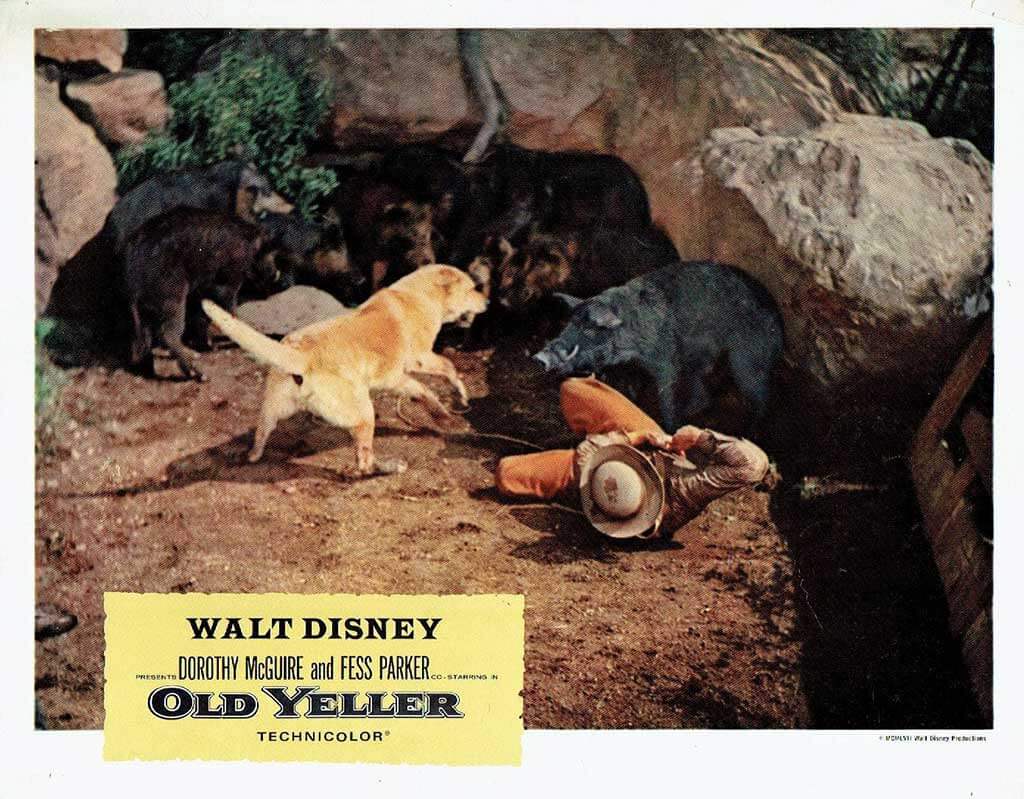
Our hogs ran loose on the range in those days, the same as our cattle. We fenced them out of the fields, but never into a pasture; we had no pastures. We never fed them, unless maybe it was a little corn that we threw to them during a bad spell in the winter. The rest of the time, they rustled for themselves.
– excerpt from Old Yeller, by Fred Gipson17 (source for the 1957 Disney movie)
Puritans also brought pigs, cows, goats and horses to North America (the Mayflower may not have carried pigs, but later ships did). William Wood,18 who lived in the Massachusetts Bay Colony from 1629 to 1633, described “swine innumerable” in his account of the colony.
It was in the British colonies where wild pigs may have first been declared a nuisance, by eating crops and ruining gardens. Free-roaming pigs would also eat corn and other crops planted by Indigenous peoples, which became a source of serious conflict. Anger over damage by pigs to an important food source was one reason behind the bloody uprising known as King Phillip’s War between Indigenous peoples and English settlers that broke out in 1675 in modern-day Massachusetts, Rhode Island and other states.19
By the close of the seventeenth century, wild pigs were well established up and down the Atlantic coast of North America.
By the early 1700s, an export trade in “pork” products (bacon, salted pork) had developed in British colonies, although in large part, pigs raised for food continued to roam free in forested areas, not confined in farmyards.7
The importation of different breeds from England for the purpose of introducing genes from pigs with desired qualities (quicker growth, larger size) into the native pig population began in the 1800s.7
As settlers and farms spread westward, the increased availability of agricultural crops may have contributed to pig’s range expansion.
François André Michaux,20 French botanist and explorer, traveled through Kentucky in the year 1802. He recounted: “Of all domestic animals hogs are the most numerous…. These animals never leave the woods, where they always find a sufficiency of food, especially in autumn and winter. They grow extremely wild, and generally go in herds. Whenever they are surprised, or attacked by a dog or any other animal, they either make their escape, or flock together in the form of a circle to defend themselves.”
On the west coast, pigs arrived in California with Spanish colonization in the late 1700s. Pigs thrived on acorns in the oak woodlands around Spanish settlements and missions.
Wild pigs could be found in at least 13 U.S. states by the late 1800s, according to the widely cited history, Wild Pigs in the United States, by John J. Mayer and I. Lehr Brisbin, Jr.8
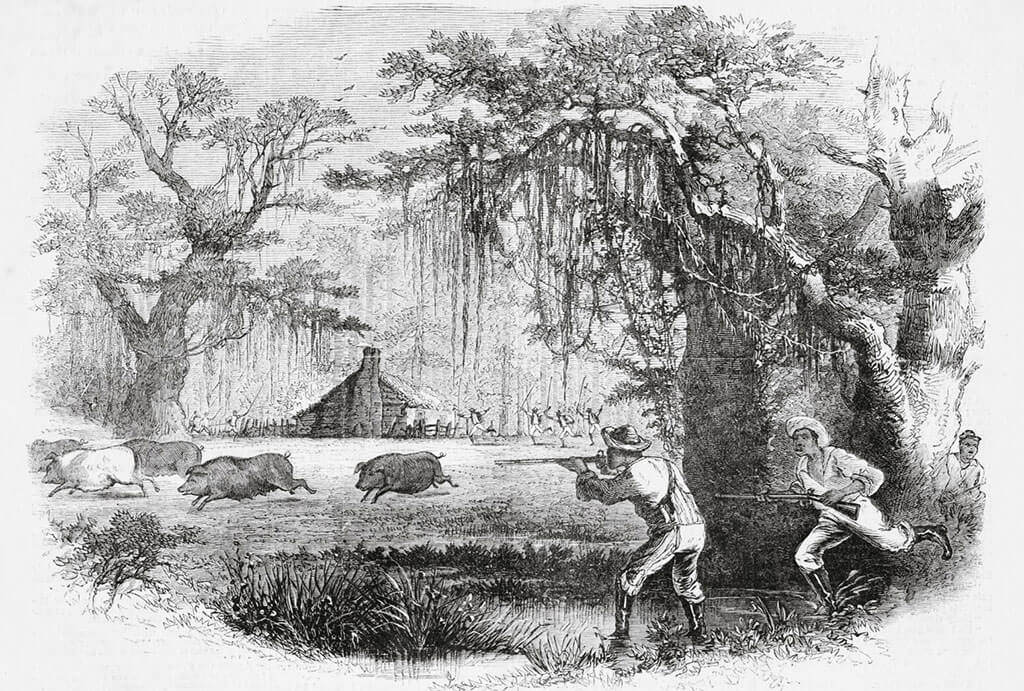
With increasing numbers of pigs living free across the country, the recreational hunting of pigs became popular. A September 1901 article in the New York Times titled “Hunting Wild Hogs as a Sport” described pigs found in many states (Mississippi, Tennessee, North Carolina, South Carolina, Kentucky, Georgia, Arkansas, Louisiana): “there are thousands upon thousands of the animals wandering through certain sections of the South. They are as wild as deer and well-nigh as formidable as the bear.”21
“Hunting Wild Hogs on the Banks of the Edisto River, South Carolina,” from Frank Leslie’s Illustrated Newspaper, September 17, 1870
Wild boar
Increasing interest in the hunting of wild pigs prompted the importation of European wild boar (aka Eurasian or Russian wild boar), a subspecies prized as a game animal. The first recorded introduction is believed to have been in 1890, when a loathsome tycoon named Austin Corbin imported a small group of boar from Europe to his private hunting preserve in New Hampshire (President Theodore Roosevelt hunted boar at the preserve in 1902).22 Another consequential introduction was in Hooper Bald, North Carolina in 1912, when 14 boar from Germany were released in a preserve owned by a wealthy hunter.23 Many of the animals and their descendants had escaped by the time the preserve closed a decade later and spread through the Appalachian Mountains (recent genetic studies have traced pigs back 100 years to Hooper Bald24).
In the 1920s, a wealthy landowner in Monterey County, California released wild boar on his land.25 There were also documented stockings of wild boar for hunting in Texas in the 1930s and 40s, and elsewhere in the country in the following decades.
Descendants of these European wild boar interbred with wild pigs already in the country, and the hybrid animals were themselves sold/transported across the country by landowners looking to establish new populations or “improve” existing populations of wild pigs.
REFERENCES
1. Diamond, Jared M. (1999). Guns, Germs, and Steel: The Fates of Human Societies. W. W. Norton & Company.
2. Barrios-Garcia, M.N., & Ballari, S.A. (2012). Impact of wild boar (Sus scrofa) in its introduced and native range: a review. Biological Invasions, 14, 2283–2300. https://doi.org/10.1007/s10530-012-0229-6
3. Ferreira, B. (2021, January 13). Pig Painting May Be World’s Oldest Cave Art Yet, Archaeologists Say. The New York Times. https://www.nytimes.com/2021/01/13/science/cave-painting-indonesia.html
4. Linderholm, A., Spencer, D., Battista, V. et al. (2016). A novel MC1R allele for black coat colour reveals the Polynesian ancestry and hybridization patterns of Hawaiian feral pigs. Royal Society open science, 3(9), 160304. https://doi.org/10.1098/rsos.160304
5. Casas, Bartolomé de las (1875). Historia de las Indias.
6. A Gentleman of Elvas (1557). A Narrative of the Expedition of Hernando de Soto Into Florida. Hackluyt, R., trans., 1609.
7. Towne, C.W. & Wentworth, E. (1950). Pigs: From Cave to Corn Belt. University of Oklahoma Press
8. Mayer, J.J. & Brisbin, I.L. (1991). Wild Pigs in the United States: Their History, Comparative Morphology, and Current Status. The University of Georgia Press.
9. Cons, J., & Eilenberg, M. (2023). Settler Colonial Beasts: Feral Pigs and Frontier Assemblages in Texas. Antipode, 0(0), 1–22. https://doi.org/10.1111/anti.12965
10. Zadik, B.J. (2005). The Iberian Pig in Spain and the Americas at the time of Columbus [Master’s thesis, University of California, Berkeley]
11. Taylor, R.B. (1993). Feral hogs: history and distribution in Texas. In: Hanselka, C.W. & Cadenhead, J.F., Eds. Feral swine: a compendium for resource managers. Texas A&M AgriLife Extension Service.
12. A Comparative View of French Louisiana, 1699 and 1762: The Journals of Pierre Le Moyne d’Iberville and Jean-Jacques-Blaise d’Abbadie. Brasseaux, C., trans., 1979. University of Southwestern Louisiana.
13. Beverley, R. (1705) The History and Present State of Virginia.
14. Michel, F.L. (1702). Report of the Journey of Francis Louis Michel from Berne, Switzerland, to Virginia, October 2, 1701-December 1, 1702. Hinkle, Wm. J., trans., 1916. The Virginia Magazine of History and Biography.
15. Crosby, A. (1986). Ecological Imperialism: The Biological Expansion of Europe, 900-1900 (2nd ed.). Cambridge University Press. https://doi.org/10.1017/CBO9780511805554
16. Swine prohibited from running at large. Louisiana Revised Statutes § 3:2891 (2010). https://legis.la.gov/Legis/Law.aspx?d=86130
17. Gipson, F. (1956). Old Yeller. Harper & Bros.
18. Wood, W. (1634). New England’s Prospect.
19. Conover, M. (2007). America’s first feral hog war. Human–Wildlife Conflicts, 1(2), 129–131. https://digitalcommons.unl.edu/hwi/92
20. Michaux, F.A. (1805). Travels to the West of the Alleghany Mountains, in the States of Ohio, Kentucky, and Tennessea, And Back to Charleston, by the Upper Carolines; Comprising the Most Interesting Details on the Present State of Agriculture, and the Natural Produce of Those Countries.
21. (1901, September 1) Hunting Wild Hogs as a Sport. The New York Times.
22.
Longpre, A. (2022, November 6). A Comprehensive History of Corbin Park. August Longpré. https://augustlongpre.substack.com/p/corbin-park-history
Evans-Brown, S. (Host). (2016, December 29). Millionaires’ Hunt Club [Audio podcast]. https://outsideinradio.org/shows/ep27
Billin, D. (2004, January 28). Private game preserve has storied history. Valley News. https://www.meyette.us/DanBillinCorbinParkArticle.htm
23. Rathbun, M. (2023, September 25). The Legendary Lodge of Hooper Bald. Our State. https://www.ourstate.com/the-legendary-lodge-of-hooper-bald/
24. McCann, B., Smyser, T., Schmit, B.; et al. (2018). Molecular Population Structure for Feral Swine in the United States. The Journal of Wildlife Management, 82(4), 821–832. https://doi.org/10.1002/jwmg.21452
25. Barrett, Reginald. (1978). The feral hog on the Dye Creek Ranch, California. Hilgardia, 46, 283-355. https://doi.org/10.3733/hilg.v46n09p283