
About Pigs
Diet
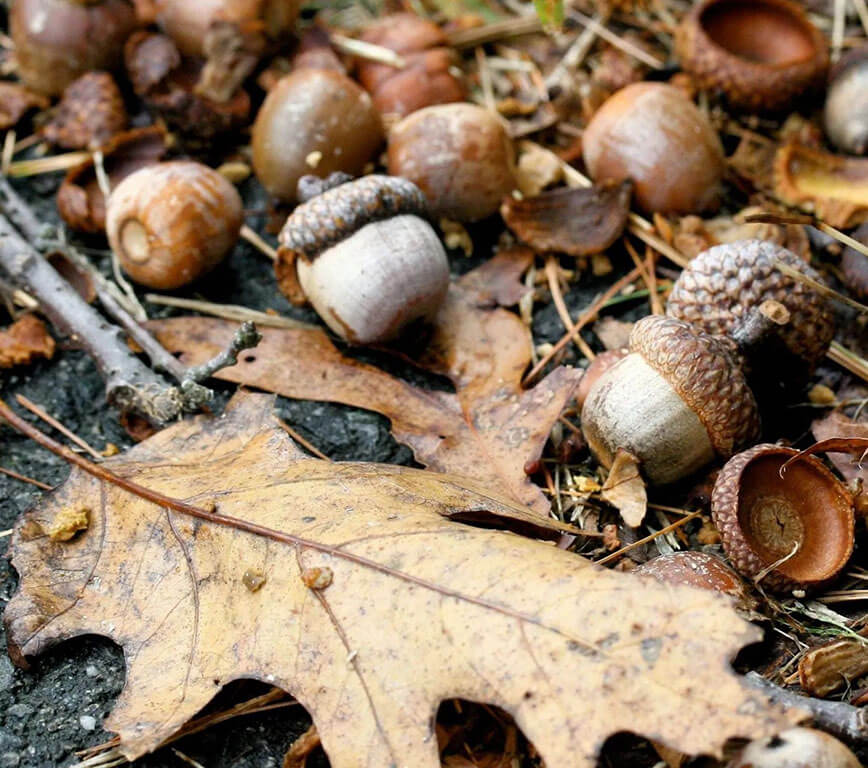
Diet
Wild pigs love to eat acorns and other nutrient-rich, high-energy nuts during season. Grass makes up a large part of their diet. Wild pigs also commonly eat flowering plants, berries, plant bulbs and roots. Their diet, and where pigs eat, changes throughout the year.
Pigs are famous for rooting, a distinctive method of finding food. Pigs use their snouts to dig, and their highly developed sense of smell to search for food in the soil. Pigs use their snouts to explore the environment; their sensitive nose and mouth are used to pick up and “feel” objects.1 Pigs can lift stones, logs and other heavy objects with their snouts. Rooting and other exploratory behaviors are enjoyable for pigs. Ethologists consider rooting to be a behavioral need; pigs in captivity suffer when prevented from rooting.2
Although plants make up most of their diet, wild pigs are omnivorous and will eat earthworms, insects and their larvae, frogs, snakes, eggs, and carrion. A 2009 study that analyzed the stomach contents of wild pigs in California found that the most common vertebrate animals consumed were voles and pocket gophers, animals who live primarily underground, leading researchers to theorize that they had been consumed opportunistically by pigs while rooting.3
The biggest factor in wild pigs’ population growth is the availability of food. When food is abundant, female pigs reach sexually maturity earlier and have more frequent and larger litters.4 The quality and quantity of food also impacts a mother pig’s lactation and piglet survival.5 When conditions are bad and pigs have difficulty finding food, pigs (like other animals) will switch resources from reproduction to survival; fewer young pigs will be born and survive.
It is more difficult for pigs to search for food when snow covers the ground for long periods, or to root when the soil is hard due to drought.6 Precipitation and temperature, especially winter temperatures, are believed to be the strongest factors influencing the natural range expansion of wild pigs.7
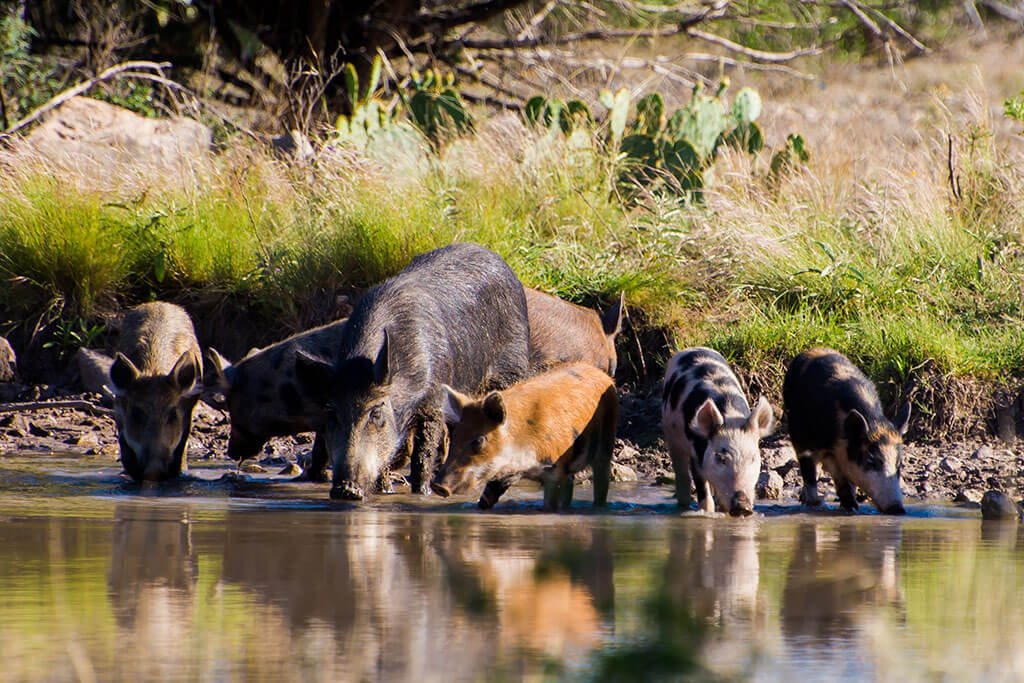
Distribution & Habitat
The home range (the area within which an animal normally lives and travels in search of food and for reproduction) of wild pigs varies widely but can be as large as 20 square miles.6 Pigs, like many animals, create paths and trails that connect different parts of their home range and are used over and over again.1 Pigs are not believed to be territorial, although there is disagreement among experts about this.
Individual boars (male pigs) may travel long distances in search of breeding opportunities. Sows (female pigs), especially if they are caring for piglets, travel less. Studies have shown that a pig’s movements are also highly correlated with seasonal changes in the availability of food and water. For example, in the Great Smoky Mountains wild pigs will move from low to high elevations, and back again, at different times of the year in search of food.8
Physical Characteristics & Behavior
Male and female pigs both have distinctive, curved tusks (canine teeth) that can be very sharp and used for defense. (In factory farms, the teeth are usually painfully clipped shortly after piglets are born.) The shape of the continuously growing tusks, and the directions they point, are different between the sexes. In fact, the differences are noticeable enough that tusks can be used to distinguish male and female adult pigs.9
Because the wild pig population in the United States is a combination of free-ranging “domestic” pigs and wild boar, there can be striking differences in the physical appearance of individual pigs—the length of their snout or legs, height of shoulders, straightness of tail, and coarseness and density of hair, among other features.
Most wild pigs are solid black in color, but there is a lot of variety. Some are solid brown, red, spotted, belted (with a white “belt”), or striped.
Wild pigs spend most of their day searching for food. During the summer heat, pigs shift to a nocturnal rhythm, resting during the day and emerging at dusk.5
Pigs are fast runners and can jump or climb over fences and the walls of traps. They are also good swimmers. According to John J. Mayer, a researcher at the Savannah River National Laboratory, pigs have been observed swimming the river “between Georgia and South Carolina in order to evade packs of hunting dogs.”1
“
Wild pigs are the smartest animal in the woods.
– Kentucky Department of Fish & Wildlife10
Pigs are curious, smart and quick learners. Pigs are able to quickly modify their behavior to avoid traps, take advantage of a new food source, or in response to human activity. Researchers with the New South Wales (Australia) Department of Agriculture related a remarkable story of pigs “acting dead” to avoid detection during aerial surveys of pigs shot from helicopters.11
Reproduction & Life Cycle
The reproductive potential (number and frequency of offspring) of wild pigs is often sensationalized, although it is true that wild pigs can reproduce faster than other large mammals in North America.12 Wild pigs typically have one litter per year, although they are capable of a second, and pigs give birth to an average of 4-7 young per litter, but sometimes 10 or more.
Shortly before giving birth, the female pig will separate herself from the group and build a nest in a secluded spot, sometimes traveling for several miles in search of the perfect spot. She’ll dig a nest in the ground and line it with grass and leaves. After giving birth, the new family stays close to the nest for at least a week, until piglets can follow their mother around.
Piglets are suckled for 3-4 months. Communal nursing has been observed within family groups of wild pigs, with sows nursing piglets of different litters.13
It is not easy to be a piglet. One extensive study of pigs at Dye Creek Ranch in northern California found piglets suffered 70-90% mortality before 6 months of age.13 The major cause was starvation. Piglets also died from accidents and predation. (The most common natural deaths for adult pigs were from tooth infections, parasites, and disease.) Wild pigs usually live to be 4 or 5 years old, although some live longer.14
Wild pigs do not grow as large or as fast as “domestic” pigs, but not because they can’t. In an experiment, researchers found that when wild pigs were raised in captivity, they were “capable of growth equal to domestic swine.”13
Genetically, wild pigs and today’s domestic pigs are not that different. When the experiment was done in reverse—when female domestic pigs were removed from factory farms and allowed to live in a natural environment—they exhibited “wild” (normal) behaviors, such as nest building. In intensive confinement farms in the U.S., the inability of pigs to root or wallow, or engage in other natural behaviors can lead to aggression and stereotypic behavior (e.g., tail biting).
Wallowing
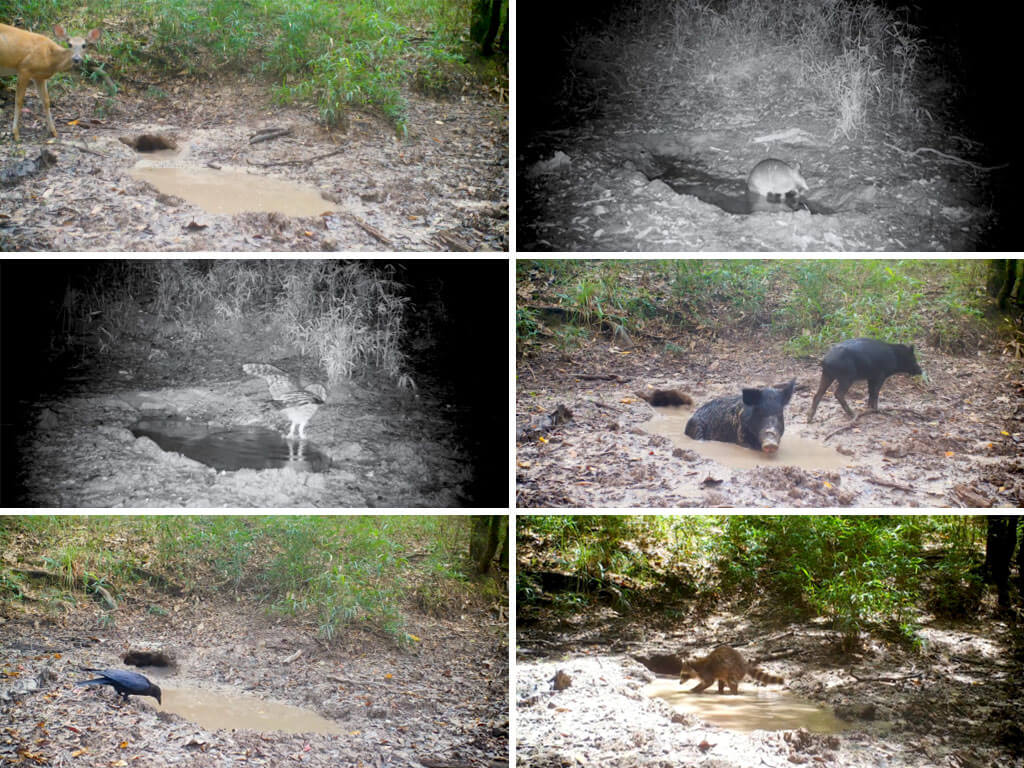
In this fascinating trail camera footage, a pig wallow in Alabama is visited by numerous forest residents including deer, armadillos, an owl, crows, raccoons, squirrels, opossums, and a coyote!
(Credit: www.youtube.com/@Michael.Outside)
Pigs are very sensitive to heat. They do not have functional sweat glands, and their body fat and thick skin put pigs at risk of overheating in hot, humid weather.
Wild pigs have developed behaviors to adapt to high temperatures, such as wallowing.
Pigs dig depressions in the dirt, often near water sources. Wallowing in mud is an effective way for pigs to cool themselves. On the hottest days, pigs enjoy wallowing longer and can become almost completely submerged in the water and mud. After leaving the wallow, the layer of mud on their body continues to keep the pig cool. The mud also protects against mosquitoes and other bugs, as well as from sunburn.
Wallows can be temporary and dry up after one summer, or they can be used over many years.1 Wallowing also has a social dimension; pigs often wallow in groups. Pigs love wallowing! Wageningen University researcher M.B.M. Bracke, who has studied wallowing in pigs, believes that wallowing is a pleasurable, relaxing activity. He notes that pigs use wallows in all seasons.15
Bison, like pigs, enjoy rolling around in wallows that they create. According to the National Park Service, bison wallows can serve as important water reservoirs for other animals and can encourage the growth of certain plants, increasing the diversity of the landscape.16 Similarly, alligators create holes that fill with water and are an important feature of the Everglades, and wild burros dig wells that become valuable water sources in desert ecosystems in the western U.S.
The potential ecological importance of wallows created by pigs—by increasing water availability for use by other animals, and by encouraging vegetation growth—deserves more research.
In 2016, researchers from the University of Georgia’s Savannah River Ecology Laboratory set up cameras at 16 wallows created by pigs.17 In addition to recording interesting pig behavior (e.g., pigs enjoy wallowing together, and visits to wallows can be as short as 1 minute or as long as one hour), the researchers observed 12 other species visiting the wallows, including raccoons, nine-banded armadillos, coyotes, white-tailed deer, crows and turkeys. Most animals visited to drink water from the wallows, but a Cooper’s Hawk and a Black vulture bathed in the water, and armadillos wallowed like pigs.
A different study found that by retaining water and keeping the soil moist, wallows create conditions favorable for seed germination, leading to “different plant composition from that on undisturbed ground.”18
Family & Social Structure
Wild pigs have a matriarchal social system. Male pigs leave their mother and family group at 9-12 months and are more solitary, except when joining groups at a food source, or when they breed.
Adult female pigs and their offspring live together in groups of 6-10 pigs (or more!) called “sounders.” Different sounders often come together when feeding at a popular spot or at a water source. A sounder can contain several generations of related animals.1 Family groups sleep close together (they enjoy physical contact), often in nests made of grass, leaves and other plants.19 Pigs prefer to shelter in dense vegetation, often using the same site for a long time.
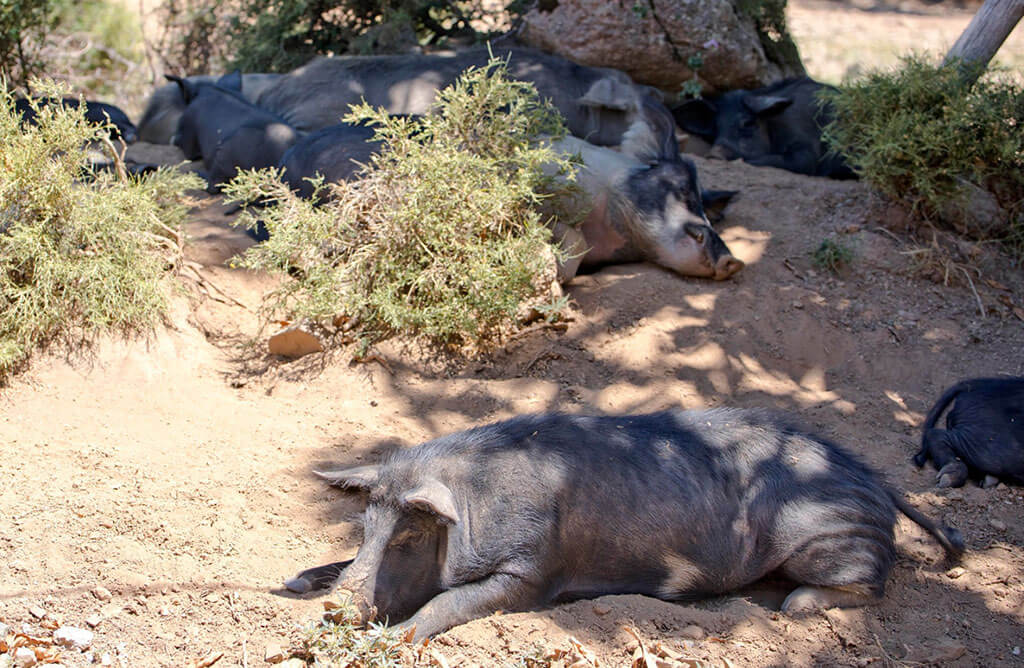
photo credit: U.S. Department of Agriculture, Natural Resources Conservation Service
“
The relationships that females form with their daughters, mothers, sisters, aunts, cousins and other female kin can last for their entire lifetimes—up to around 15 years or more, if they make it that far. They experience a version of love; of this I have no doubt.
– excerpt from Groundbreakers, by Chantal Lyons (2024)20
The social behavior of wild pigs is an area that has not received much attention from researchers.21 But we do know that pigs communicate with scent, body language and vocal communications. Visual signals such as tail and ear movements can convey emotions. Squeals, grunts and other sounds can indicate fear or frustration, but also happiness and positive feelings.19,22
REFERENCES
1. Mayer, J. (2009). Wild Pig Behavior. In Mayer, J.J. & Brisbin, I.L. (Eds.), Wild Pigs: Biology, Damage, Control Techniques and Management. (pp.77-104). Savannah River National Laboratory.
2. Studnitz, M., Jensen, M.B. & Pedersen, L.J. (2007). Why do pigs root and in what will they root?: A review on the exploratory behaviour of pigs in relation to environmental enrichment. Applied Animal Behaviour Science, 107(3–4), 183-197. https://doi.org/10.1016/j.applanim.2006.11.013
3. Wilcox, J. & van Vuren, D. (2009). Wild Pigs as Predators in Oak Woodlands of California. Journal of Mammalogy, 90(1), 114-118. https://doi.org/10.1644/08-MAMM-A-017.1
4. Ditchkoff, S.S., Holtfreter, R.W. & Williams, B.L. (2017). Effectiveness of a bounty program for reducing wild pig densities. Wildlife Society Bulletin, 41, 548-555. https://doi.org/10.1002/wsb.787
5. Barrett, Reginald. (1978). The feral hog on the Dye Creek Ranch, California. Hilgardia, 46, 283-355. https://doi.org/10.3733/hilg.v46n09p283
6. Hayes, R., Riffell, S., Minnis, R., et al. (2009). Survival and Habitat Use of Feral Hogs in Mississippi. Southeastern Naturalist, 8(3), 411–426. http://www.jstor.org/stable/25599335
7. Snow, N.P., Jarzyna, M.A. & VerCauteren, K.C. (2017). Interpreting and predicting the spread of invasive wild pigs. Journal of Applied Ecology, 54, 2022-2032. https://doi.org/10.1111/1365-2664.12866
8. B.B. Ackerman, M.E. Harmon, & F.J. Singer (1978). Seasonal Food Habits of European Wild Boar – 1977 Great Smoky Mountains National Park. In Singer, F.J. (Ed.), Studies of European Wild Boar in the Great Smoky Mountains National Park. Upland Field Research Laboratory, Great Smoky Mountains National Park. http://purl.clemson.edu/9D1C37B591A98D8BDDDE11DFB1D7E6C6
9. National Institute of Food and Agriculture (2019, August 28). Feral Hog Tusk Characteristics. U.S. Department of Agriculture. https://feralhogs.extension.org/feral-hog-tusk-characteristics/
10. Kentucky Department of Fish & Wildlife Resources. Wild Pig Frequently Asked Questions. https://fw.ky.gov/InvasiveSpecies/Documents/FAQ_final.pdf
11. Saunders, G. & Bryant, H. (1988). The Evaluation of a Feral Pig Eradication Program During a Simulated Exotic Disease Outbreak. Australian Wildlife Research, 15: 73–81.
https://doi.org/10.1071/WR9880073
12. Engeman, R.M., Constantin, B.U., Shwiff, S.A., et al. (2007). Adaptive and economic management methods for feral hog control in Florida. Human-Wildlife Interactions. https://doi.org/10.26077/GVRC-SB22
13. Barrett, Reginald. (1978). The feral hog on the Dye Creek Ranch, California. Hilgardia, 46, 283-355. https://doi.org/10.3733/hilg.v46n09p283
14. Mapston, M. (2017). Feral Hogs in Texas. Texas A&M Natural Resources Institute. https://nri.tamu.edu/publications/extension-publications/2007/feral-hogs-in-texas/
15. Bracke, M.B.M. (2011). Review of wallowing in pigs: Description of the behaviour and its motivational basis. Applied Animal Behaviour Science, 132(1–2), 1-13. https://doi.org/10.1016/j.applanim.2011.01.002
16. National Park Service. (2017, November 2). Bison Bellows: What’s Wallowing All About? U.S. Department of the Interior. https://www.nps.gov/articles/bison-bellow-1-28-16.htm
17. Eckert, K.D., Keiter, D.A., & Beasley, J.C. (2019). Animal Visitation to Wild Pig (Sus scrofa) Wallows and Implications for Disease Transmission. Journal of Wildlife Diseases, 55(2), 488–493. https://doi.org/10.7589/2018-05-143
18. Eldridge, D.J. & Soliveres, S. (2023). Rewilding soil-disturbing vertebrates to rehabilitate degraded landscapes: benefits and risks. Biology Letters, 19(4), 20220544. https://doi.org/10.1098/rsbl.2022.0544
19. Humane World for Animals. (2015, May). About Pigs. https://www.humaneworld.org/sites/default/files/docs/about-pigs.pdf
20. Lyons, C. (2024). Groundbreakers. Bloomsbury Wildlife. https://www.bloomsbury.com/us/groundbreakers-9781399401623/
21. Beasley, J.C., Ditchkoff, S.S., Mayer, J.J., et al. (2018), Research priorities for managing invasive wild pigs in North America. The Journal of Wildlife Management, 82, 674-681. https://doi.org/10.1002/jwmg.21436
22. Marino, L., Colvin, C. & Torgerson-White, L. Thinking Pigs: Cognition, Emotion, and Personality. Kimmela Center for Animal Advocacy, and Farm Sanctuary. https://assets.farmsanctuary.org/content/uploads/2021/12/14130857/pig-white-paperV4.pdf