
You Can Help
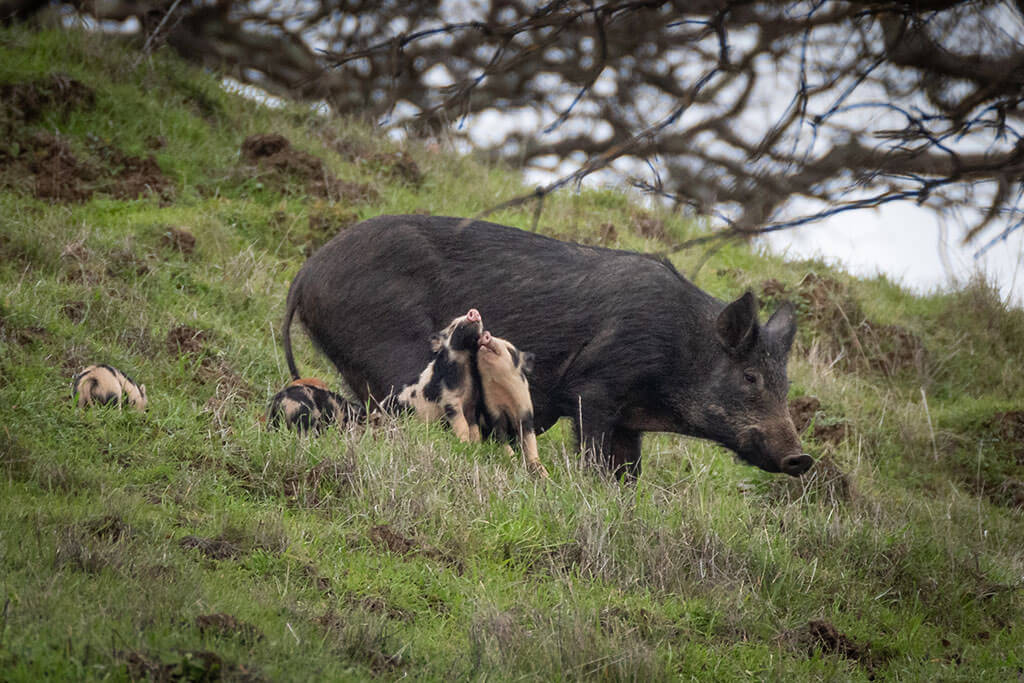
A family of pigs in California. Photograph by Eric / iNaturalist.
Be a voice for wild pigs!
Please share the unique history and biology of wild pigs with others. If you see a story in your local newspaper about wild pigs that repeats the same old criticisms, consider responding with a letter to the editor. If your letter is published, please send us a copy!
Advocate for change in state laws or regulations
According to the Southeastern Association of Fish and Wildlife Agencies (SEAFWA), with members representing 15 states, the most important steps for preventing the spread of wild pigs in states without pigs or with small populations are:
(a) Increasing penalties and stronger enforcement of laws to stop the illegal possession, transport and release of wild pigs. According to the SEAFWA, the intentional relocation of wild pigs is the “primary means by which populations are established in new areas.”1
Many states allow the transport of wild pigs to slaughter facilities, and several states allow the transport to and release of pigs on hunting ranches. However, SEAFWA warns, “ensuring that all shipments of live wild hogs arrive at a legally allowable destination is problematic.” SEAFWA recommends that states enact transport prohibitions without exceptions.
Ask your state legislators to work to strengthen laws to discourage the illegal transport and release of wild pigs. For example, in 2021, the Missouri legislature passed legislation which made it illegal to transport, release, or possess feral swine; the bill also increased penalties.2 Contact us for details of laws regarding wild pigs in your state.
(b) Ban sport hunting of wild pigs. This may sound counterintuitive. Hunters often claim to play an important role in controlling the pig population, but research suggests otherwise. Hunting is not an effective method of controlling wild pigs, and has been shown to encourage the illegal relocation of wild pigs.
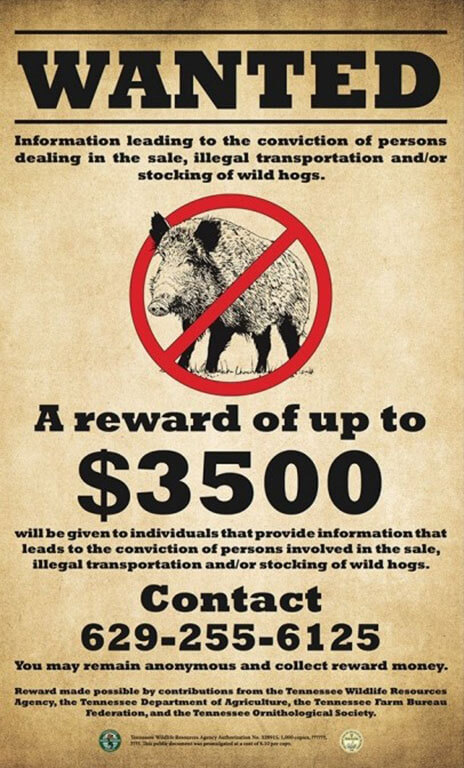
In 1999, the Tennessee Wildlife Resources Agency (TWRA) opened a statewide wild pig hunting season in an attempt to control the expansion of the wild pig population.3 Unfortunately, as the TWRA explained, “it was during this period of unlimited hunting that the wild hog population expanded the most. Disjointed populations of hogs began to occur in areas of Tennessee where they had never existed before as the result of illegal stocking by individuals whose goal was to establish local hunting opportunities.” There is no longer a hunting season for wild pigs in Tennessee. In 2011, changes took effect that removed pigs from “big game” status, and Tennessee now offers a reward to encourage reports of illegal transport/release.
The hunting of wild pigs should be illegal. By eliminating economic/recreational incentives, the illegal introduction of wild pigs into new areas will be reduced.
Regulations that only target the importation and release of wild pigs have not been effective. For some hunters and landowners, the rewards, economic and otherwise, for releasing wild pigs, outweigh the risks of getting caught.4 In 2016, conservation officers in Alabama’s Division of Wildlife and Freshwater Fisheries arrested 16 people for illegally transporting and releasing wild pigs. According to a press release, their investigation revealed “an accepted culture among some hog hunters where laws governing possession or transport of live feral hogs were ignored.”5 They added, “We documented feral pigs being trussed up and transported in car trunks, dog boxes and back seats of vehicles for release elsewhere.”
Hunting bans are an increasingly popular response to the expansion of pigs’ range. In December 2024, the Ohio Legislature unanimously adopted a wild pig hunting ban.6 Kentucky, where pigs were first reported in the late 1980s, banned sport hunting of wild pigs in 2023.7 (Kentucky offers free trapping services to landowners experiencing damage from wild pigs.) Pig hunting is also banned in Kansas, Minnesota, Montana, Nebraska, New York, Nevada, North Dakota and Utah.8 Wildlife agencies in Missouri and Virginia “strongly discourage” recreational hunting of pigs, although hunting is not illegal on private land.9
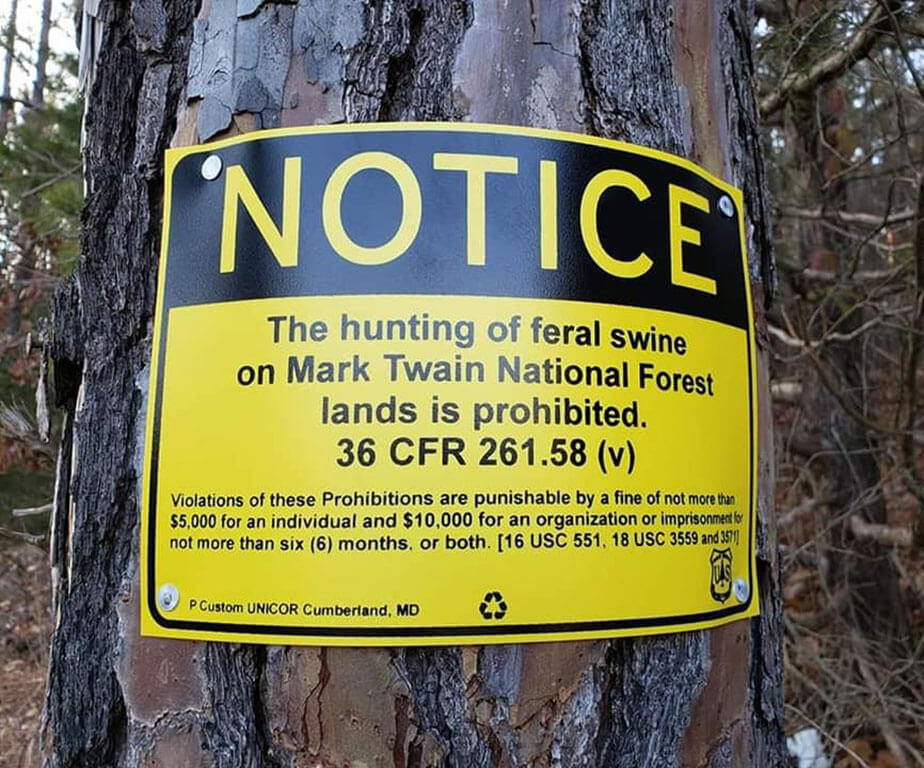
In addition, the U.S. Forest Service and the National Park Service have closed public lands to pig hunting to reduce hunter incentives to move and release pigs.10
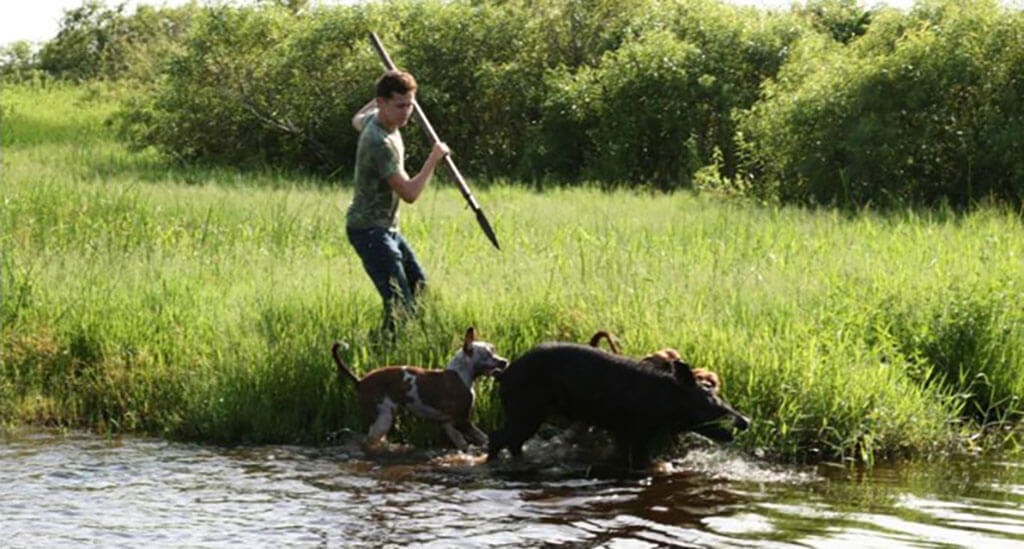
(c) Remove animal fighting exceptions. The use of “catch dogs” in hunting wild pigs is as bloody and violent as dogfighting, which is a felony crime in all 50 states. Unfortunately, in many states the statutes that criminalize animal fighting (dogfighting, cockfighting) include exclusions for wild animals and/or for hunting. Please contact your state legislators and ask them to introduce legislation to remove the exemption in your state’s animal fighting law that allows hunters to use dogs to attack wild pigs. Please contact us for details of animal fighting laws in your state.
Contact your state wildlife agency
Contact your state wildlife agency and demand a ban on the use of inhumane weapons, such as knives, spears and swords, used by hunters to kill wild pigs. In the hands of the average hunter, these weapons do not kill animals with speed and certainty. (California is the only state to specify, “Spears, knives and other methods … are not allowed for hunting wild pigs.”11)
Encourage nonlethal control techniques
When pigs cause problems, eating crops for example, calls for control are legitimate and understandable. If you learn of a proposed pig “management” plan, speak up and encourage consideration of nonlethal control techniques.
A contraceptive injection (GonaCon) used to reduce populations of horses, white-tailed deer and other wildlife is being studied for use in wild pigs, but has not yet been approved.12
Support our work
Thank you for visiting our website! Your donation helps us expand our advocacy efforts on behalf of wild pigs, and to encourage understanding, empathy and appreciation of these unique animals.
REFERENCES
1. Southeastern Association of Fish and Wildlife Agencies (2023). 2023 Annual State Summary Report, Wild Hog Working Group.
https://www.fishwildlife.org/application/files/1916/9723/5071/SEAFWA_WHWG_State_Summary_2023.pdf
2. Release of swine to live in wild or feral state, penalties. Revised Statutes of Missouri § 270.260 (2021) https://revisor.mo.gov/main/OneSection.aspx?section=270.260
3. Tennessee Wildlife Resources Agency. Hogs in Tennessee. https://www.tn.gov/twra/wildlife/mammals/large/wild-hog.html
4. Caudell, J.N., Dowell, E., & Welch, K. (2016) Economic utility for the anthropogenic spread of wild hogs. Human–Wildlife Interactions. 10(2).
https://doi.org/10.26077/hpy5-x934
5. Alabama Department of Conservation and Natural Resources. (2016, November 28). 16 Arrested in 3 States for Transport, Release or Possession of Live Feral Pigs [Press release]. https://www.outdooralabama.com/node/1527
6. Prohibitions. Ohio Revised Code. § 1533.75 (2025) https://codes.ohio.gov/ohio-revised-code/section-1533.75
7. Species with Restricted Take. Kentucky Administrative Regulations. § 301 KAR 3:030:4 (2024) https://apps.legislature.ky.gov/law/kar/titles/301/003/030/
8.
Feral swine; prohibited acts related to such swine. Kansas Statutes. § 47-1809 (2012) https://ksrevisor.gov/statutes/chapters/ch47/047_018_0009.html
Feral swine. Minnesota Statues. § 97A.56 (2024) https://www.revisor.mn.gov/statutes/cite/97A.56
Feral Swine; Prohibitions. Montana Code. § 81-29-104 (2023) https://archive.legmt.gov/bills/mca/title_0810/chapter_0290/part_0010/section_0040/0810-0290-0010-0040.html
Wild pigs. Nebraska Revised Statutes. § 37-524.01 (2005) https://nebraskalegislature.gov/laws/statutes.php?statute=37-524.01
Eurasian boar. New York Codes, Rules, and Regulations. Tit. 6 § 180.12 (2014) https://www.law.cornell.edu/regulations/new-york/6-NYCRR-180.12
Unlawful to take up or feed estray or feral livestock. Nevada Revised Statutes. § 569.040 (2013) https://www.leg.state.nv.us/nrs/nrs-569.html#NRS569Sec040
Feral Swine; Prohibited actions. North Dakota Century Code. § 36-26-03 (2009) https://ndlegis.gov/cencode/t36c26.pdf
Release of swine or feral swine for any purpose. Utah Agricultural Code. § 4-25-302 (2017) https://le.utah.gov/xcode/Title4/Chapter25/4-25-S302.html ,
Feral swine detrimental to state’s interests. Utah Agricultural Code. § 4-25-303 (2025) https://le.utah.gov/xcode/Title4/Chapter25/4-25-S303.html
9.
Missouri Department of Conservation. Feral Hogs in Missouri. (“Hunting hogs on other lands is strongly discouraged.”) https://mdc.mo.gov/wildlife/invasive-animals/feral-hogs-missouri
Virginia Department of Wildlife Resources. Feral Hogs. (“DWR strongly discourages recreational (sport) hunting of feral hogs”) https://dwr.virginia.gov/wildlife/feral-hogs/hunting-faq/
10. Natural Resources Conservation Service, U.S. Department of Agriculture. (2023). USDA NRCS National Feral Swine Damage Assessment Preliminary Findings.
https://www.nrcs.usda.gov/sites/default/files/2023-04/USDANationalDamageAssessmentPreliminaryFindings_03_27_23.pdf
11. California Department of Fish and Game. (2001.) Guide to Hunting Wild Pigs in California. https://nrm.dfg.ca.gov/FileHandler.ashx?DocumentID=23231&inline
12. U.S. Department of Agriculture, Animal and Plant Health Inspection Service. (2015). Final Environmental Impact Statement: Feral Swine Damage Management: A National Approach. https://www.aphis.usda.gov/sites/default/files/us-2015-fs-damage-mgt-a-national-approach-eis.pdf