
Nonnative (Introduced) Species
Nonnative species are essential to America’s economy and culture. The most common domesticated animals in the U.S. (chickens, cows, sheep, goats, horses, and cats), many of the grains, fruits, and vegetables grown on U.S. farms (wheat, apples, oranges, potatoes, carrots and lettuce) as well as important crops like cotton, all are nonnative and followed similar methods and timelines of introduction to the United States as the pig.
Time has shown that as a nonnative species (we prefer the term, introduced species) becomes established, people often grow accustomed to it and consider its presence normal.1 Introduced birds, such as the common pigeon, house sparrow and European starling, are now among the most familiar birds in the U.S. The common dandelion was introduced in the 1600s (dandelions sailed on the Mayflower!). Many of the species of earthworms in the U.S. arrived during the 18th century in dirt from Europe. The most common species of honeybee were introduced into North America as early as 1622 by English colonists. The bees developed important relationships with native plants and became important economically. (There are many examples of introduced species having a beneficial relationship with native species, acting as pollinators, seed dispersers or food sources.2)
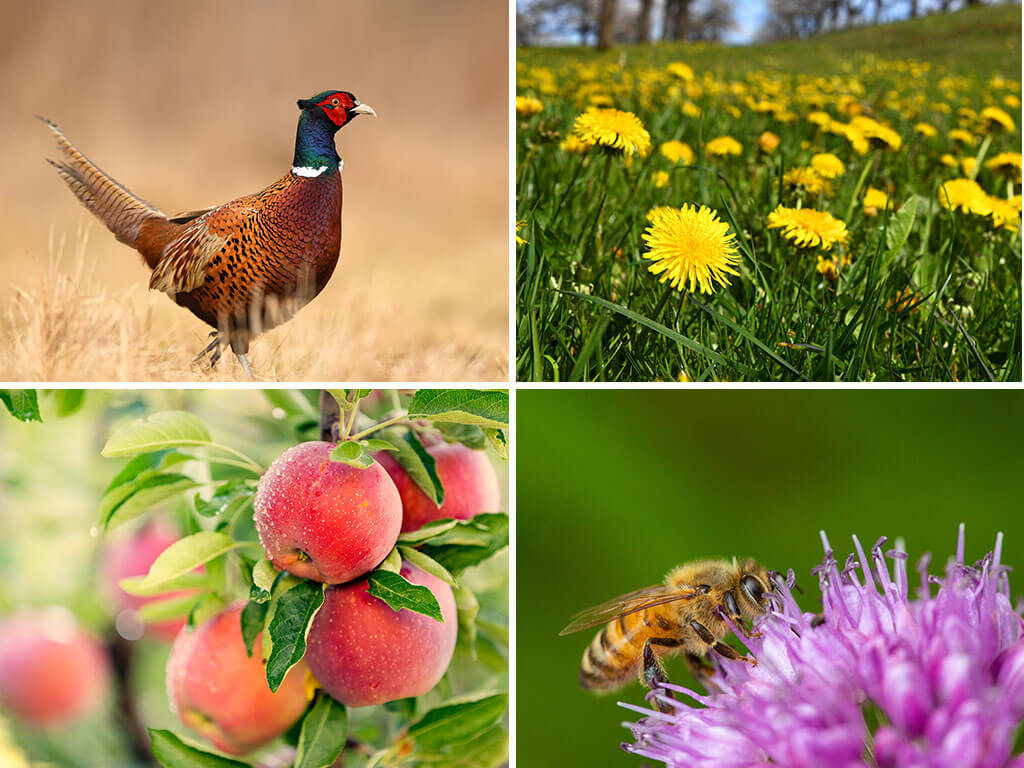
Can you spot the nonnative species? It’s a trick question.
“
Many of the alien species among us have become an integral part of our community and our cuisine–cattle, cotton, corn, and striped bass are surely as American as sunflower seeds, cranberries, and Jerusalem artichokes.
– Mark Sagoff, “What’s Wrong with Exotic Species?”3
In recent centuries, as our relationship with nature became increasingly commodified, humans in North America reshaped natural habitats to a much greater extent than prior to the arrival of Europeans. We built roads and dams, dug canals, hunted birds for feathers and food and sport, almost destroyed entire ecosystems (tallgrass prairie), and caused the extinction or near extinction of many species (passenger pigeons, bison). Humans have helped species overcome geographic barriers such as oceans and mountains that would otherwise have made range expansion impossible.4 In modern times, the rate of environmental change has increased.5
It is undeniable that some introduced species, especially pathogens and insects, have caused harm. Introduced predators have caused extinctions, particularly in isolated habitats like islands or lakes. One of the most dramatic recent examples is the brown tree snake that contributed to the extinction of several bird species in Guam after its introduction in the 1950s.
But despite popular belief, it cannot be generalized that “nonnatives” are harmful. You may be surprised to learn that the vast majority of the many thousands of species introduced into the U.S. and who have established self-sustaining populations have not had negative impacts.
On the other hand, many native species have negative effects. There is a long list of native plants and animals that when abundant, or when reacting to a change in their environment, can cause economic damage and negative ecological effects, including crows, sea lions, even the bald eagle (blamed for hurting loon populations in Minnesota by preying on loon chicks). Ecologist Mark Davis6 provides the example of the mountain pine beetle, a native bark beetle that has destroyed millions of acres of pine forest in the U.S.
Introduced species may have negative, neutral, or even positive effects.7 This is also true of the effects native species have on one another. The divide between native and nonnative is artificial. “Ultimately, nonnative species are just species,” Davis concluded in his cleverly titled essay, “Do Native Birds Care Whether Their Berries Are Native or Exotic? No.”8
For many in the scientific community, as Mark Davis9 explains, the assumption has long been, “native species are desirable while nonnatives were not.” Nonnative/introduced species inevitably cause harm, it was assumed, and removing those species was necessary for an ecosystem to heal. But a growing number of scientists are acknowledging that nativeness or coevolutionary history is less important than behavior and function in an ecosystem.10
A meta-analysis by ecologist Erick Lundgren11 and colleagues found that native and introduced herbivores like wild pigs do not have “distinct effects” in a plant community. Instead, functional traits—preference for certain foods, in particular—better explained large herbivores effects on plants.
“
We found no evidence that nativeness shapes the effects of megafauna on plants. Our results are corroborated by other meta-analyses that have failed to find consistent differences between the effects of native and introduced organisms.
– Erick Lundgren et al., “Functional traits—not nativeness—shape the effects of large mammalian herbivores on plant communities.” (Science 2024)11
Lundgren, whose research has included the impacts of feral donkeys on plants and animals in desert ecosystems, suggests studying introduced animals not as introduced animals, but simply as wildlife, “as any other wildlife would be studied.”11 Lundgren argues, “Pervasive attitudes towards introduced species, based on the idea that some ‘belong’ and some don’t, can prevent us from seeing the world as it really is.” In his book, The New Wild: Why Invasive Species Will Be Nature’s Salvation, science writer Fred Pearce asks, “Please judge the species… by what they do or don’t do and not by the label attached to them.”12
Instead of the simplistic native/nonnative terms, maybe it would be better to use terms that distinguish how long a species has been present in an environment, like “long-term resident species” or “recently arrived species,” terms used by Mark Davis, or “new natives,” a term used by Pearce, or maybe “long-established species”?
Some commentators have suggested that the rhetoric and arguments surrounding nonnative plants and animals– for example, wild pigs as “invaders” who contaminate the purity of America– are similar to the anti-immigrant, close-the-borders xenophobia of some Americans.13,14,15,16
Jonah H. Peretti15 has compared the fear of nonnative species to nativism (native=good, immigrants=bad). He wrote that there are “compelling arguments that nativist purism is undesirable in all spheres – politically, culturally and ecologically. Nature and society are both complex and damaged systems. To protect biological life and create a better society we must move beyond simplistic, purist responses to ecological and social crises.”
Beavers use their sharp teeth to cut down trees for food and for constructing dams and lodges.
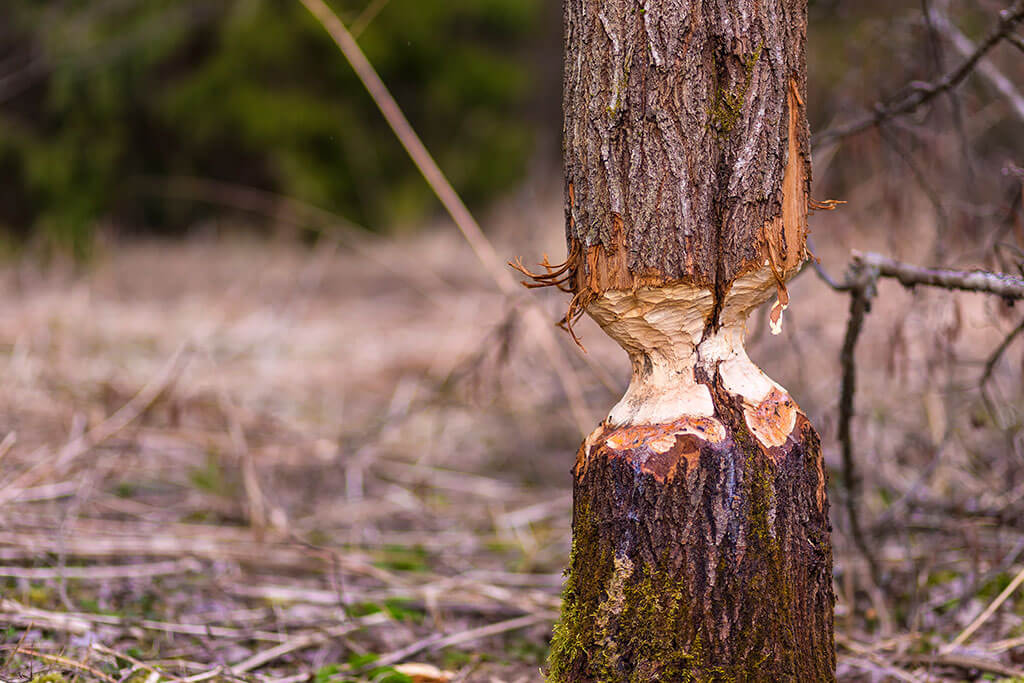
Are wild pigs in the U.S. so different than “native” animals? Do pigs have unusual or outsized impacts? Is there a characteristic or behavior that distinguish them as nonnative? Behaviors such as digging into the ground in search of food or wallowing in mud are not unnatural or unique to pigs. If a biologist did not have historical evidence that pigs were not native to North America, could they tell? If an ecologist had not already identified pigs (or other animals) as nonnative, could they determine which habitat had been “invaded”, a question asked by the late environmental philosopher Mark Sagoff.17 Yes, results of rooting or wallowing could be identified, but that ecologist would also see streams dammed by beavers, bark stripped from trees by porcupines, holes and dirt mounds created by prairie dogs, swarms of grasshoppers, etc. How would they determine which habitat had been invaded, which had suffered ecological harm?
“
If the natural history record is incomplete, there is no reliable ecological or biological method that can distinguish between aliens and natives. Furthermore, it is unclear how long a species needs to be established in a location before it is considered native. Is a species ‘naturalised’ in 100 years, 1,000 years, or 10,000 years? The distinctions are arbitrary and unscientific.
– Jonah H. Peretti, “Nativism and Nature: Rethinking Biological Invasion” (Environmental Values 1998)15
Recent reassessments have placed introduced species below other threats to biodiversity globally, such as habitat loss, land-use changes, human development, over-harvesting, pollution, and climate change. Bird species that have gone extinct in North America since the arrival of Europeans (for example, passenger pigeon, Carolina parakeet, Bachman’s warbler, and ivory-billed woodpecker) perished due to overhunting and habitat loss, and not competition or predation by introduced species.18
Nature is flexible and resilient, not fragile
The 525-page Environmental Impact Statement about wild pigs that was finalized by the USDA in 2015 repeated a common refrain in support of the argument that nonnative species have an outsized impact: ecosystems in the United States “did not evolve with feral swine.”19 That’s true up to a point, but evolution did not stop in the 16th century when pigs arrived in the continental U.S. We learned from Darwin that nature is a work in progress, and that species that are adaptable to change will survive. Species evolve or otherwise adapt in response to changes in their environment. For example, western red cedar trees on an archipelago in British Columbia evolved a defensive response (changes in palatability) less than 100 years after the introduction of deer.20 It is likely that pigs have adapted to their “new” environment in America, and it’s likely that adaptation has been mutual over the past 450+ years, with plants, insects, mammals and other animals also adapting and evolving to the presence of pigs.
Disturbance is common in many ecosystems.
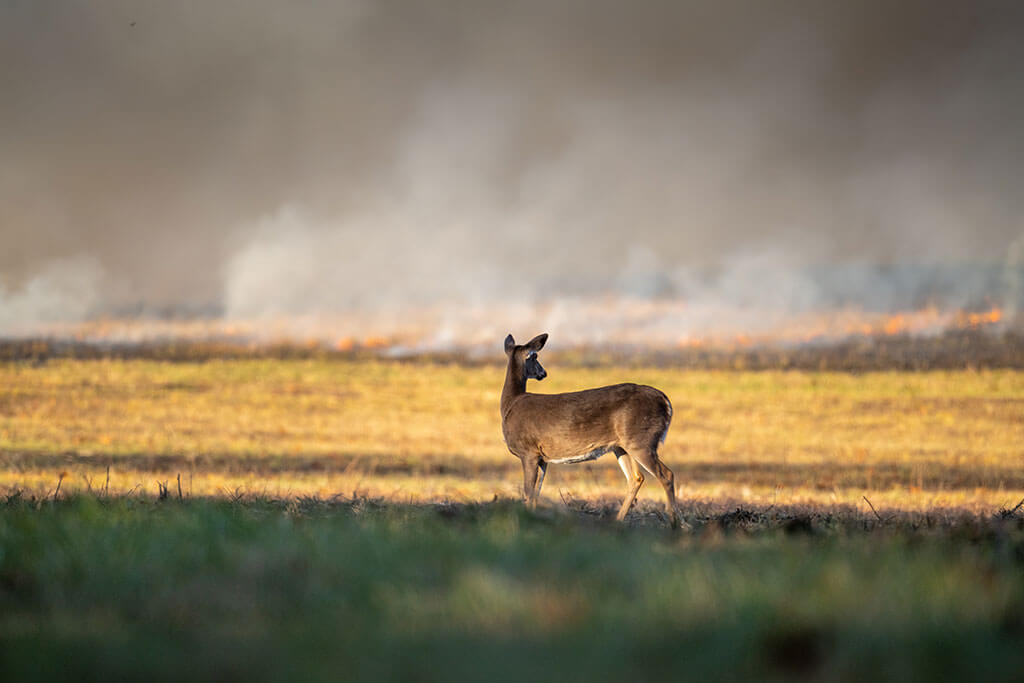
Disturbance is common in many ecosystems.
The traditional idea of the “balance of nature,” with plants and animals in specialized relationships with each other, existing in harmony, has been replaced by a more nuanced view.21 Most ecologists now view nature as dynamic and complex, with the combinations of species that make up any given ecosystem changing over time, sometimes dramatically. It is natural for animals to move into new habitats in search of food, or for reproduction, or in response to changes in the ecosystem. It would be hard to find an ecosystem in the U.S. that does not contain species of different historical and geographic origins, just as it would be challenging to find a habitat composed entirely of “native” species.
Environmental philosophers Ned Hettinger and Bill Throop22 argue that instead of stability, “disturbance is the norm” for many ecosystems, both large scale disturbance, like climate change, and small scale, more frequent disturbances, such as fires and floods and droughts, or the introduction of a new species. And in response, “species adapt to each other, to disturbances, and to changing environments.”
In the short-term, the introduction of new species, like any disturbance, can be disruptive.23 But in the longer term, ecosystems adapt to changes, and new community members are assimilated. New species may be introduced because of human actions (accidental and deliberate), or chance. And species interact, and respond to change, in the ecosystem in different ways (from extinction to no response at all).
There is debate about whether the “invasive species problem” will get worse due to climate change. For some species, temperature and rainfall play an important role in limiting expansion, but for pigs, any impact of an increase in atmospheric CO2 concentration will likely be based on how plants respond (i.e., will it be easier for pigs to find food?). Mild winters could make the environment at the edges of their northern range in the U.S. more livable, but for pigs temperature alone isn’t the biggest factor for survivability.
Mark Davis asks if the native/nonnative terminology will matter much due to a warming planet, if both native and nonnative species will encounter an altered environment, and become (quoting Reise, 2006), “all strangers in a strange environment.”24
REFERENCES
1. Schlaepfer, M.A., Sax, D.F. & Olden, J.D. (2011). The potential conservation value of non-native species. Conservation biology: the Journal of the Society for Conservation Biology, 25(3), 428–437. https://doi.org/10.1111/j.1523-1739.2010.01646.x
2. Goodenough, A.E. (2010). Are the ecological impacts of alien species misrepresented? A review of the “native good, alien bad” philosophy. Community Ecology, 11, 13–21. https://doi.org/10.1556/ComEc.11.2010.1.3
3. Sagoff, M. (2002). What’s Wrong with Exotic Species?. In: W. Galston (Ed.), Philosophical Dimensions of Public Policy (pp. 327-340). Routledge. https://10.4324/9781315126357-34
4. Hulme, P.E. (2003). Biological invasions: winning the science battles but losing the conservation war? Oryx, 37(2), 178–193. https://doi:10.1017/S003060530300036X
5. Hobbs, R., Arico, S., Aronson, J. et al. (2006). Novel ecosystems: theoretical and management aspects of the new ecological world order. Global Ecology and Biogeography, 15(1–7). https://doi.org/10.1111/j.1466-822X.2006.00212.x
6. Davis, M., Chew, M., Hobbs, R. et al. Don’t judge species on their origins. Nature, 474, 153–154 (2011). https://doi.org/10.1038/474153a
7. Davis, M.A. (2013). Invasive Plants and Animal Species: Threats to Ecosystem Services. In: R. Pielke, (Ed.), Climate Vulnerability (pp. 51-59). Academic Press. https://doi.org/10.1016/B978-0-12-384703-4.00405-6
8. Davis, M. (2011). Do Native Birds Care Whether Their Berries Are Native or Exotic? No. BioScience, 61(7), 501–502. https://doi.org/10.1525/bio.2011.61.7.2
9. Davis, M. (2019). Defining nature: Competing perspectives: between nativism and ecological novelty. Metode Science Studies Journal, (9), 101–107. https://doi.org/10.7203/metode.9.10878
10. Donfrancesco, V., Allen, B.L., Appleby, R. et al. (2023). Understanding conflict among experts working on controversial species: A case study on the Australian dingo. Conservation Science and Practice, 5(3). https://hdl.handle.net/10072/439833
11. Lundgren, E.J. et al. (2024). Functional traits—not nativeness—shape the effects of large mammalian herbivores on plant communities. Science, 383, 531-537. https://doi.org/10.1126/science.adh2616
12. Pearce, F. (2015). The New Wild: Why Invasive Species Will Be Nature’s Salvation. Beacon Press.
13. Coates, P. (2005). Eastenders Go West: English Sparrows, Immigrants, and the Nature of Fear. Journal of American Studies, 39(3), 431–462. http://www.jstor.org/stable/27557692
14. Subramaniam, B. (2001). The Aliens Have Landed! Reflections on the Rhetoric of Biological Invasions. Meridians, 2(1), 26–40. https://doi.org/10.1215/15366936-2.1.26
15. Peretti, J.H. (1998). Nativism and Nature: Rethinking Biological Invasion. Environmental Values, 7(2), 183-192. https://doi.org/10.3197/09632719812934153
16. Wallach A.D., Bekoff M., Batavia C. et al. (2018). Summoning compassion to address the challenges of conservation. Conservation Biology, 32(6), 1255-1265. https://doi.org/10.1111/cobi.13126
17. Sagoff, M. (2005). Do Non-Native Species Threaten The Natural Environment? Journal of Agricultural and Environmental Ethics, 18(3), 215-236.
https://doi.org/10.1007/s10806-005-1500-y
18. Davis, M. (2003). Biotic Globalization: Does Competition from Introduced Species Threaten Biodiversity? BioScience, 53(5), 481–489. https://doi.org/10.1641/0006-3568(2003)053[0481:BGDCFI]2.0.CO;2
19. U.S. Department of Agriculture, Animal and Plant Health Inspection Service. (2015). Final Environmental Impact Statement: Feral Swine Damage Management: A National Approach. https://www.aphis.usda.gov/sites/default/files/us-2015-fs-damage-mgt-a-national-approach-eis.pdf
20. Vourc’h, G., Martin, JL., Duncan, P. et al. (2001.) Defensive adaptations of Thuja plicata to ungulate browsing: a comparative study between mainland and island populations. Oecologia, 126, 84–93. https://doi.org/10.1007/s004420000491
21. Cronon, W. (1996). Uncommon Ground. W. W. Norton & Company
22. Hettinger, N., & Throop, B. (1999). Refocusing Ecocentrism: De-emphasizing Stability and Defending Wildness. Environmental Ethics, 21(1), 3–21. https://www.jstor.org/stable/48843126
23. Vermeij, G. (2005.) Invasion as expectation: A historical fact of life. In: Sax, D.F., Stachowicz, J.J. & Gaines, S.D., Eds. Species Invasions: Insights into Ecology, Evolution and Biogeography. Sinauer Associates Inc.
24. Reise, K., Olenin, S. & Thieltges, D.W. (2006). Are aliens threatening European aquatic coastal ecosystems? Helgoland Marine Research, 60, 77–83. https://doi.org/10.1007/s10152-006-0024-9