
Wild Pig Impacts
Video of pigs rooting in a forest in Florida.
It is impossible to generalize or make predictions when speaking about the ecological impacts of wild pigs. Biologists who study introduced species agree that impacts are complex, often with both negative and positive, short-term and long-term, minor or substantial effects. The impacts of wild pigs in a habitat where they are newcomers will likely be different than in a habitat where pigs have existed for hundreds of years. Their impact may be different in a forest vs. a swamp, and so on. Impacts vary depending on the number/density of pigs in a habitat, and the intensity of activity. Our intention with this website is not to hide the negative impacts of wild pigs, but we will challenge alleged impacts that are not supported by strong evidence.
“
There have been many studies examining the effects that feral hogs have on vegetative communities as a result of feeding and/or rooting. … The effects that these activities have on vegetation may be positive or negative depending on climate, plant community and land use goals of the property manager. Positive effects may include a decrease in insect pests, increased quality of seed beds, increased water infiltration, a shift in plant succession toward increased diversity, accelerated decomposition of organic matter and increased mixing of soil horizons. Negative effects may include soil erosion, consumption of native seed crops, consumption of threatened or endangered species, altered plant succession and reduction of overall species diversity. … Feral hogs represent many unknowns, and, as one biologist so precisely put it, ‘feral hogs are an ecological black box.’ … More research and practical knowledge is needed to provide a better understanding of the feral hog and its influence on game and nongame species and the environment.
– Oklahoma’s Noble Research Institute, the largest independent agricultural research organization in the U.S.1
Changes in plant communities
Not surprisingly, when pigs eat large amounts of acorns or tree seedlings they change the composition of the forest. A 7-year study in Texas’ Big Thicket National Preserve found that wild pigs did not change the number of young trees in the preserve but did effect the variety of trees and other plants.2 Wild pigs were also found to decrease the amount of dead leaves and other organic matter on the forest floor and increase exposed soil. A different study found similar impacts– increased bare ground, and reduced numbers of voles and shrews who live in dense vegetation– from wild pigs in the Great Smoky Mountains National Park.3
A long-term study in oak woodlands in California found that rooting and foraging by wild pigs, in areas where pig densities were high, negatively impacted the survival and growth of oak trees.4 However, other factors, including development, disease, livestock grazing, and climate change are much greater threats to this imperiled ecosystem.
Biologist Peter Kotanen5 studied the responses of vegetation to disturbance by wild pigs in a California coastal prairie and determined that like other natural and human-caused change in the environment, the presence of wild pigs have effects that vary according to, “the biology and disturbance history of the affected community.”
The impacts of “native” animals
Of course, pigs are not the only animal that consumes tree nuts or seedlings. Numerous studies have found that white-tailed deer, by selectively foraging, can dramatically change the composition of trees and other plants in a forest with cascading effects on insects, birds, and other animals.6 Other large, native herbivores such as elk, sheep, bison and moose can change the composition of plant species and entire ecosystems by eating, trampling, and even with their urine. The grazing of bison, for example, shaped North American grasslands prior to the arrival of Europeans.7
Moose arrived in Isle Royale (Michigan) in the early 1900s, likely swimming to the remote island from mainland Ontario. Scientists have studied how selective foraging by moose, eating hardwoods but avoiding conifers, have altered the composition and the nutrient cycle of the forest. Moose have significantly changed the island’s unique ecosystem since their arrival but have also become symbols of Isle Royale National Park.8,9 There has been discussion of “managing” the animals, but no rush to lethal control as when pigs present similar challenges.
Selective feeders, such as deer and moose, by eating preferred plants, tend to decrease diversity in plant communities (if biodiversity is defined as the number of species present in an ecosystem), whereas nonselective feeders like pigs tend to increase diversity. According to ecologist Erick Lundgren and colleagues,10 “Feral pigs often increase plant diversity, at times doubling native plant diversity by suppressing competitive dominants” (plants that outcompete others for limited resources). By eating everything, including the dominant, most abundant plants (plants that a selective feeder may not prefer), pigs provide other plants with an opportunity to thrive. A 2021 study of pigs in marshes in coastal Georgia found similar effects—foraging and trampling by pigs suppressed dominant plants, resulting in a more diverse plant community (the researchers found this change to be long-lasting).11 The researchers mentioned the American alligator as another animal that has big, pervasive impacts on marshes.
Soil disturbance
Soil disturbance is the most conspicuous “damage” caused by wild pigs, with consequences that vary by plant community, ecosystem (e.g., grasslands vs. forests, deep-rooted vs. shallow-rooted plants), the frequency/intensity of the disturbance, and the time since the initial disturbance.
When pigs overturn soil to feed on plants or invertebrates below ground, they also affect the growth and survival of young trees, shrubs and grasses. Disturbance changes the composition of plant species.12 Some plants do not grow back, but disturbance may encourage the growth of other plants (overturning soil may also have positive effects for some insects and birds).
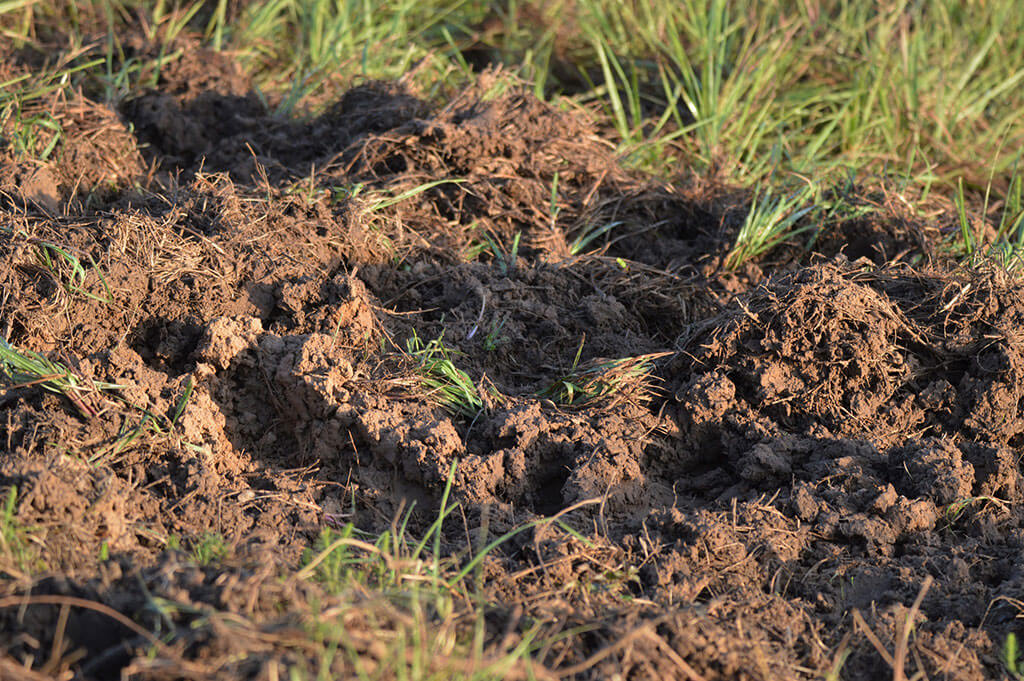
Soil-disturbing animals around the world are important in creating and maintaining ecosystems. In North America, pocket gophers and prairie dogs, bears, skunks and armadillos dig in the ground to find food or to create shelter. When these animals, like wild pigs, create disturbances in the soil, there is a mix of effects. Studies of “soil disturbances” (mounds and burrows) created by pocket gophers revealed some short-term negative effects in the grassland ecosystem, but over the long-term, native plant species recover, and are resilient to the disturbances.13 The intensity of pigs’ disturbance of the soil may be greater than pocket gophers, but rooting by pigs can have similar ecological impacts as disturbances by other animals.5
In a 2015 Environmental Impact Statement reviewing the impacts of wild pigs, the USDA explained, “In some situations impacts of feral swine rooting can be beneficial or rooting may have little impact on the system. Rooting can be similar to tilling in crops which increases nutrient cycling and decomposition rates, but also increases nitrogen loss through leaching or direct erosion of soil.”14
One of the conclusions in a widely cited literature review by ecologists M. Noelia Barrios-Garcia and Sebastián Ballari12 was that some plants “are more resilient to disturbance” by pigs, and that soil and vegetation can recover quickly, especially in areas with regular disturbances. Peter Kotanen5 found that one year after pigs’ rooting in his study site, the number of different plants returned to (or exceeded) undisturbed levels (Kotanen was careful to add that the results “should not be interpreted as evidence that pig-created disturbances are environmentally benign”).
A four-year “exclosure” experiment (in which pigs were excluded from an area by fencing) in northern California concluded that disturbances caused by wild pigs did not affect soil nutrients or soil moisture.15 Instead, the researchers hypothesized that rooting by wild pigs created conditions (“space clearing”) that allowed new plants to establish and grow. In the study area, pigs did alter vegetation, but with the numbers of both native and nonnative plants increasing in disturbed areas. Another conclusion of the study, that the researchers described as “striking,” was that native bunchgrasses were largely unaffected by pig disturbances, perhaps because the native grasses were deep-rooted, and could better tolerate soil disturbance. In contrast, the study found that disturbances reduced some nonnative grasses that may have less anchoring roots, and less ability to tolerate soil disturbance.
The takeaway from the many conflicting studies of the ecological impacts of wild pigs is that nature is complicated. Pigs can and do cause disruption and harm, but often their presence has positive effects, or no effect at all.
Damage to Agricultural Crops
Wild pig damage to corn field; photo by Arkansas Game and Fish Commission
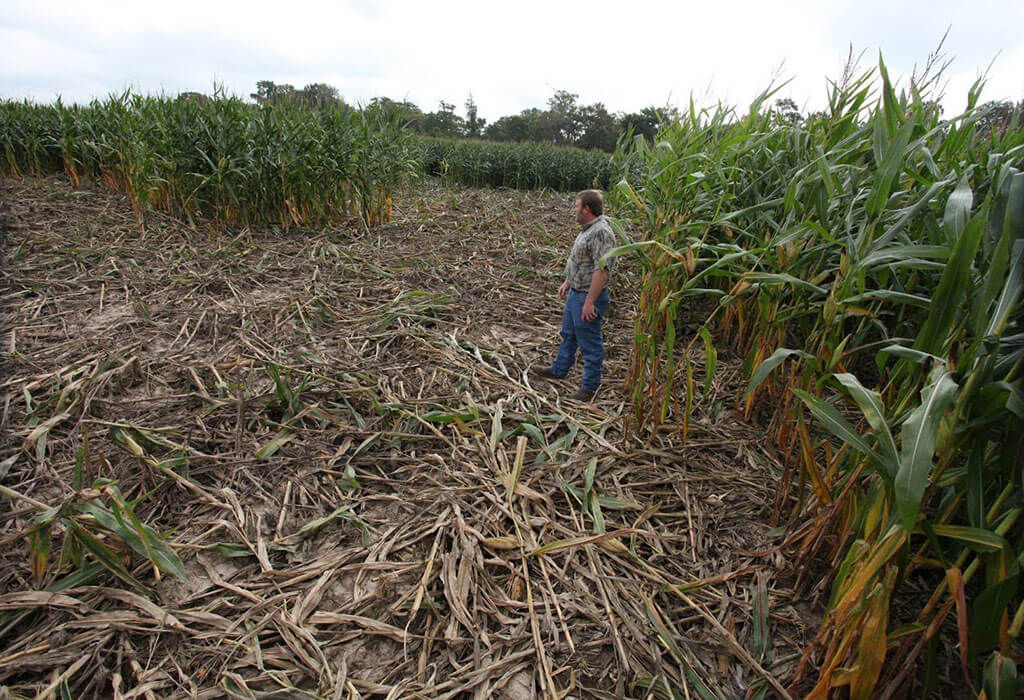
Wild pig damage to corn field; photo by Arkansas Game and Fish Commission
The most common reason that wild pigs are killed is to protect agricultural lands. Pigs eat crops or trample them, and overturn fields during foraging, and while wallowing. Pigs eat or damage corn, soybeans, peanuts, wheat, hay, cotton, and other commercial crops (e.g., Texas peanut producers reported, “A group of hogs can root up, trample, or consume several acres of a field or pasture in a single night.”16). In the southern U.S, pigs uproot seedlings at tree nurseries and eat the soft roots of pines and other trees, resulting in extensive and costly damage. Agricultural crops often are not wild pigs’ preferred food. Multiple studies have found that damage to crops is limited when natural resources are plentiful.12,17
Pigs are also blamed for damaging fences and water systems on agricultural land, and eating food set out for livestock. There is anecdotal evidence of pigs preying on young sheep, goats or other livestock18,19, but there are questions of whether the animals were indeed killed by pigs or eaten as carrion.
Non-agricultural damage caused by wild pigs includes damage to golf courses, cemeteries, landscaping and suburban lawns, irrigation systems, dikes, landfills, and other public and private property.
Stories about wild pigs almost always include astronomical economic damage estimates. These are rough calculations, of course, and usually include the costs of removing pigs as well as damages. For example, a presentation during a USDA meeting on “invasive species” in 2007 used estimated crop damages and “control costs of $300 per pig,” assuming that 5 million wild pigs lived in the U.S., to come up with a number of $1.5 billion in annual damages.25 (Crop damages are themselves extrapolated from small-scale surveys.26) The amount was increased to $3 billion in more recent assessments.37 It is wrong to value animals only for their benefits or harm to humans.27 Unfortunately, economics dominate decision-making about wildlife at the government level.
USDA Wildlife Services
The goal for most state agencies is eradication of wild pig populations when and where possible. But much of the actual killing is done by the U.S. Department of Agriculture’s Wildlife Services, a federal program that also covers some of the costs.
Wildlife Services has been described as the “hired gun” of the agriculture industry. For much of the 20th century, the program’s focus was to exterminate predators like coyotes; millions of the misunderstood animals were killed (see Dan Flores’ excellent book, Coyote America20).
Wildlife Services is controversial for its use of poison and other cruel methods, and for targeting animals at the request of private landowners, farmers, and local governments, sometimes with little if any evidence of damage.21 Unfortunately, even critics of the program gloss over the enormous numbers of “invasive species” killed.
Today, wild pigs are the #1 mammal targeted by Wildlife Services, and the #2 animal overall (European starlings made up 77% of all animals killed in 2025 by Wildlife Services!). In 2025, government sharpshooters and trappers killed 131,740 wild pigs in 30 states (more than twice the number of coyotes killed).22
Wildlife Services proudly states that the vast majority of all conflicts it responds to are resolved using nonlethal methods (fencing, guard dogs, relocation, contraceptives). But with wild pigs, only lethal methods are used. The most common methods are traps (a group of pigs can be trapped at one time using a cage or corral-style trap, and then shot with a rifle) and aerial gunning from a helicopter. The USDA is developing a sodium nitrate poison for lethal control of pigs.14
Competition for resources
In this photo taken at a hunting ranch in Georgia, pigs, deer and turkey congregate at a feeder.
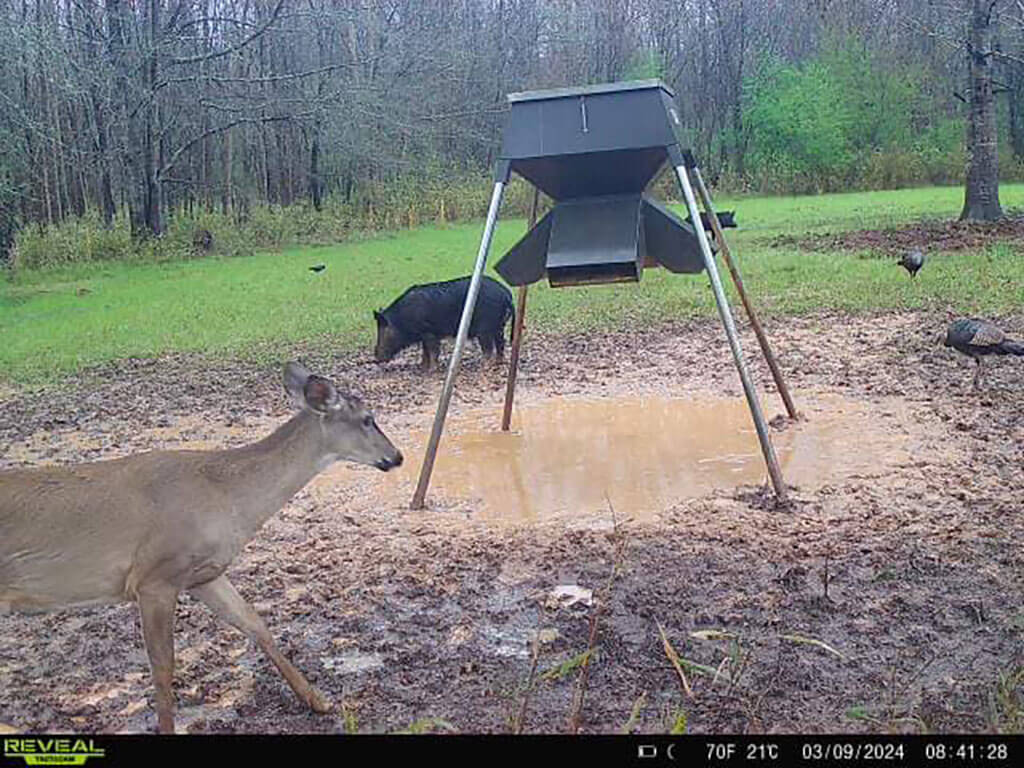
In this photo taken at a hunting ranch in Georgia, pigs, deer and turkey congregate at a feeder.
A common concern about introduced or nonnative species is that they outcompete native species for resources. Wild pigs have been accused of competing for food with native species, in particular “game animals” like deer and wild turkeys. Pigs and deer both eat acorns, but there is no evidence that this “competition” has impacted the deer population. A study by USDA Forest Service scientists found that deer make small adjustments in their behaviors to avoid wild pigs, but “no evidence that wild pigs broadly displace deer from using an area.”38 Pigs have been accused of raiding turkey nests for eggs. Texas and Florida have healthy wild turkey populations despite also having large pig populations.
Competition is a good example of harm that is often associated with wild pigs, but with little consideration of degree. Wild pigs, like most animals in an environment, compete for food, water, space and other resources. But unless the resources are limited, is there a negative impact?
Pigs in the continental U.S. have not been linked to species extinctions or even local extirpations (wild pigs did contribute to the extinction of the Dodo bird on the island of Mauritius in the 1600s and to the near extinction of the Galapagos tortoise).
High densities of pigs have been linked to fecal contamination of streams and rivers. Pigs are not unique in this respect; large numbers of Canada geese, cormorants, and white-tailed deer can also lead to increased bacteria levels. Researchers in Louisiana found bacteria in water samples taken from streams near where wild pigs had been active.23,24 They concluded that pig poop resulted in decreased numbers of freshwater mussels, and they predicted that the bacteria could be harmful to fish or other organisms in the streams. Surprisingly, the researchers found positive as well as negative impacts on invertebrates. Some bugs and snails were more abundant in response to pig activity. The study also predicted that the pig manure would not have long-term impacts if pigs did not use one site for long periods of time. Pigs can also contribute to soil erosion, in a similar way that free-range cattle can reduce water quality, by destabilizing stream banks and muddying the water.
Predation
How does ecological research begin? Many studies of wild pigs do not start with an identified problem or observation (other than, wild pigs are present in a habitat). Instead, the research begins with a question, such as, what is the impact of wild pigs on [plant or animal] in [study area]? The presumption is unacknowledged: wild pigs are nonnative, their presence must lead to negative impacts. The (potential) negative impacts are often presented as the takeaway from the study; other interpretations of the study’s objective findings are not presented.
A 2010 study of wild pigs on the Fort Benning Military Installation (Georgia/Alabama) was not launched in response to an observed decrease in toad numbers, for example, but instead was merely an exploration into what pigs eat.28 Pigs were shot and their stomach contents examined. Among the contents were five different species of reptiles and amphibians, leading to the speculative conclusion that wild pigs could, “potentially have a negative impact on species.” Millions of reptiles and amphibians may be consumed by pigs each year, the researchers estimated, but because population numbers of herpetofauna in the study area were not known, the researchers admitted, “it is difficult to estimate the impact that depredation by wild pigs might have on any individual species.”
This is not to say that wild pigs do not have negative impacts. Pigs do eat eggs of ground-nesting birds and sea turtles, for example. On Cayo Costa, an island off Florida’s west coast, a 2010 study found that pigs eat eggs from sea turtle nests, although raccoons were identified as the primary nest predator.29 The study did not reveal the extent of wild pig predation of turtle nests, but any loss of eggs has an impact for an endangered species. A USDA Environmental Assessment completed in 2022 also included pigs on a list of predators of sea turtle nests and hatchlings in Florida but noted raccoons as the most significant predators (accounting for 90% of sea turtle nest predation in south Florida), followed by red foxes and coyotes.30
Disease
Descriptions of wild pigs inevitably mention the potential of wild pigs to spread parasites (ticks) and infectious diseases. The important word is “potential”!
According to the USDA, “Feral swine can carry at least 30 diseases and nearly 40 types of parasites that may affect people, pets, livestock, and wildlife.”31 Each year, the USDA’s Wildlife Services program takes thousands of samples from wild pigs across the country to test for African Swine Fever, Swine Brucellosis and other diseases. Wild pigs in the U.S. do carry both swine brucellosis and pseudorabies. There have been cases of hunters becoming ill with brucellosis after butchering infected pigs or contracting trichinosis after eating contaminated wild pig flesh, and there have been fatal cases of pseudorabies in dogs used to hunt pigs. But wild pigs do not pose health risks to humans in general, and there is little evidence that wild pigs have transmitted disease to livestock (brucellosis vaccinations can protect cattle who may encounter wild pigs). The commercial herd of pigs in the U.S. is considered free of pseudorabies (since 2004) and brucellosis (since 2011).26 If you’ve seen a factory farm, where pigs are confined indoors 24×7 from birth until they are sent to the slaughterhouse, it is hard to imagine how wild pigs could come into contact with captive pigs. Although in the small but growing alternative of pasture-based pig farming there is a higher likelihood of encountering wild pigs.
The fact is that all animals are capable of carrying and spreading disease. Wild pigs are no different.
Control
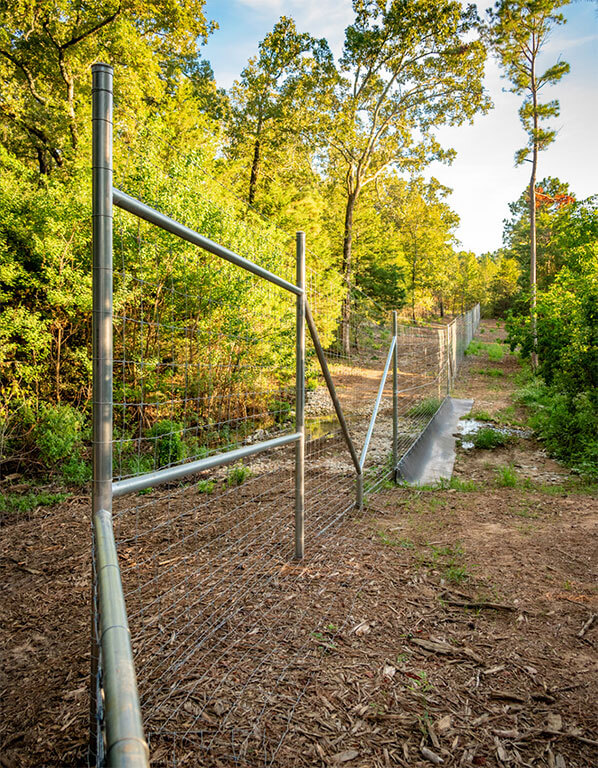
“Hog-proof” fencing by Tejas Ranch & Game Fence (tejasranchfence.com).
We appreciate the approach of “compassionate conservation,” a discipline that prioritizes nonlethal strategies in resolving conflicts between humans and wildlife and avoids “practices that intentionally and unnecessarily harm” animals, as described by ecologist Arian Wallach and colleagues.32 Conservation goals can be achieved while being compassionate toward individual animals. We agree with the idea that animal welfare concerns should be a part of decision making about management options.33 In some cases, it may be better not to intervene. In other cases, lethal control may be part of the solution.
Non-lethal approaches, such as fencing, can be effective in protecting property, but may not be a realistic option for large properties.
Most states do not have dedicated funding for pig control, and it’s expensive. The 2018 Farm Bill (2018-2023) awarded $75 million for the Feral Swine Eradication and Control Pilot Program!
Focused (lethal) removal efforts can reduce agricultural damage, at least temporarily.34 But repeated removals may be necessary because pig populations can rebound quickly.39 With trapping, University of Georgia professor Michael Mengak40 explains, the important number is not how many pigs are trapped, it’s the number of pigs left behind. More often, it is impossible to remove all wild pigs from an area, given limited resources. Since funding for projects to protect and restore the environment is limited, it is necessary to choose where to focus pig control efforts. An example of a priority area would be a remote island habitat where any benefits of removing pigs would be long-term (where it is unlikely that pigs would recolonize). Or perhaps new or small populations elsewhere.
“
It is a mistake to misdirect valuable and increasingly scarce conservation funds into unwinnable wars.
– Chris D. Thomas, “The Anthropocene could raise biological diversity” (Nature 2013)35
Lethal options can successfully control small populations of wild pigs. For example, the National Park Service eradicated pigs from California’s Santa Cruz Island. A decade-long effort by federal agencies to remove pigs from the Havasu National Wildlife Refuge in Arizona has been mostly successful (a few individual pigs may remain).41
A few states (Nebraska and Oregon, for example) that once had small numbers of wild pigs now claim to be “pig free” following control efforts.
What about hunting? State wildlife agencies and wildlife biologists agree that public hunting is not an effective method of reducing pig numbers. Hunters are not able to kill enough animals to impact the overall population. In fact, hunting (especially when hunters use dogs) has been found to spur pigs to leave the area and sometimes expand into new, previously unpopulated areas. Hunting pressure may also cause pigs to become nocturnal.
We wish the following questions would be asked before wild pigs are killed: Are pigs causing serious harm, or is their “nonnative” status the reason for the action? Is there a good chance that control efforts will be successful? How much resources would be required? Are the potential benefits worth the costs? Would removing pigs make for a healthier, more resilient ecosystem? If killing pigs is to protect/restore natural areas, are there other environmental projects that have more potential value?36 Finally, could the eradication of an established population of pigs have unintended ecological effects?
Preventing wild pigs from establishing (or re-establishing) new populations, in new areas, may be the best use of resources. See You Can Help for information about legislative efforts to discourage the transport and release of wild pigs.
REFERENCES
1. Stevens, R. (2026). The Feral Hog in Oklahoma. Noble Research Institute. https://www.noble.org/ag-publications/wildlife/feral-hog-in-oklahoma/
2. Siemann, E., Carrillo, J., Gabler, C. et al. (2009). Experimental test of the impacts of feral hogs on forest dynamics and processes in the southeastern US. Forest Ecology and Management 258, 546-553. https://doi.org/10.1016/j.foreco.2009.03.056
3. Singer, F.J., Swank, W.T., Clebsch, E.E.C. (1984). Effects of Wild Pig Rooting in a Deciduous Forest. The Journal of Wildlife Management 48(2), 464–473. https://doi.org/10.2307/3801179
4. Sweitzer, R.A. & Van Vuren, D.H. (2002). Rooting and foraging effects of wild pigs on tree regeneration and acorn survival in California’s oak woodland ecosystems. In: Proceedings of the Fifth Symposium on Oak Woodlands: Oaks in California’s Challenging Landscape. Pacific Southwest Research Station, Forest Service, U.S. Department of Agriculture. http://dx.doi.org/10.2737/PSW-GTR-184
5. Kotanen, P.M. (1995). Responses of vegetation to a changing regime of disturbance: effects of feral pigs in a Californian coastal prairie. Ecography 18(2), 190–199. https://doi:10.1111/j.1600-0587.1995.tb00340.x
6. Tremblay, J-P., Côté, S., Rooney, T. et al. (2014). Ecological impacts of deer overabundance on temperate and boreal forests. Annual Review of Ecology Evolution and Systematics 35, 114-147. https://doi.org/10.1146/annurev.ecolsys.35.021103.105725
7. Trager, M.D., Wilson, G. & Hartnett, D.C. (2004). Concurrent Effects of Fire Regime, Grazing and Bison Wallowing on Tallgrass Prairie Vegetation. The American Midland Naturalist 152(2), 237–247. http://www.jstor.org/stable/3566716
8. Pastor, J., Dewey, B., Naiman, R.J. et al. (1993). Moose Browsing and Soil Fertility in the Boreal Forests of Isle Royale National Park. Ecology 74(2). https://doi.org/10.2307/1939308
9. McInnes, P.F., Naiman, R.J., Pastor, J. et al. (1992). Effects of Moose Browsing on Vegetation and Litter of the Boreal Forest, Isle Royale, Michigan, USA. Ecology 73(6), 2059–2075. https://doi:10.2307/1941455
10. Lundgren, E.J. et al. (2024). Functional traits—not nativeness—shape the effects of large mammalian herbivores on plant communities. Science 383, 531-537. https://doi.org/10.1126/science.adh2616
11. Hensel, M.J.S., Silliman, B.R., Hensel, E. et al. (2022). Feral hogs control brackish marsh plant communities over time. Ecology 103(2). https://doi.org/10.1002/ecy.3572
12. Barrios-Garcia, M.N., & Ballari, S.A. (2012). Impact of wild boar (Sus scrofa) in its introduced and native range: a review. Biological Invasions 14, 2283–2300. https://doi.org/10.1007/s10530-012-0229-6
13. Rogers, W., Hartnett, D. & Elder, B. (2001). Effects of Plains Pocket Gopher (Geomys bursarius) Disturbances on Tallgrass-prairie Plant Community Structure. The American Midland Naturalist 145(2), 344-357. https://doi.org/10.1674/0003-0031(2001)145[0344:EOPPGG]2.0.CO;2
14. U.S. Department of Agriculture, Animal and Plant Health Inspection Service. (2015). Final Environmental Impact Statement: Feral Swine Damage Management: A National Approach. https://www.aphis.usda.gov/sites/default/files/us-2015-fs-damage-mgt-a-national-approach-eis.pdf
15. Cushman, J., Tierney, T. & Hinds, J. (2004). Variable effects of feral pig disturbances on native and exotic plants in a California grassland. Ecological Applications 14(6), 1746-1756. https://doi.org/10.1890/03-5142
16. Tolleson, D.R., Pinchak, W.E., Rollins, D. et al. (1995). Feral Hogs In The Rolling Plains of Texas: Perspectives, Problems, and Potential. Great Plains Wildlife Damage Control Workshop Proceedings. 124-128. https://digitalcommons.unl.edu/gpwdcwp/454
17. Geisser, H. & Reyer, H.-U. (2005). The influence of food and temperature on population density of wild boar Sus scrofa in the Thurgau (Switzerland). Journal of Zoology 267, 89-96. https://doi.org/10.1017/S095283690500734X
18. Rollins, D., Higginbotham, B.J., Cearley, K.A. et al. (2007). Appreciating feral hogs: extension education for diverse stakeholders in Texas. Human–Wildlife Interactions 1(2), 192-198. https://doi.org/10.26077/w8vd-cc32
19. Seward, N., Vercauteren, K., Witmer, G. et al. (2004). Feral Swine Impacts on Agriculture and the Environment. Sheep and Goat Research Journal 19. https://digitalcommons.unl.edu/icwdmsheepgoat/12
20. Flores, D. (2016). Coyote America: A Natural and Supernatural History. Basic Books.
21. Project Coyote (2026). Reforming Wildlife Services. https://projectcoyote.org/protect/reforming-wildlife-services/
22. Wildlife Services (2024). Program Data Report 2024. U.S. Department of Agriculture, Animal and Plant Health Inspection Service. https://www.aphis.usda.gov/wildlife-services/publications/pdr
23. Kaller, M.D., Hudson, J.D., Achberger, E.C. et al. (2007). Feral Hog Research in Western Louisiana: Expanding Populations and Unforeseen Consequences. Human–Wildlife Interactions 1(2). https://doi.org/10.26077/8wde-q136
24. Kaller, M.D. & Kelso, W.E. (2006). Swine Activity Alters Invertebrate and Microbial Communities in a Coastal Plain Watershed. The American Midland Naturalist 156(1), 163-177. https://doi.org/10.1674/0003-0031(2006)156[163:SAAIAM]2.0.CO;2
25. Pimental, D. (2007). Environmental and economic costs of vertebrate species invasions into the United States. In: Witmer, G.W., Pitt, W.C., & Fagerstone, F.A., eds. Managing Vertebrate Invasive Species: Proceedings of an International Symposium. National Wildlife Research Center, U.S. Department of Agriculture. https://digitalcommons.unl.edu/nwrcinvasive/38
26. Bevins, S., Pedersen, K., Lutman, M. et al. (2014). Consequences Associated with the Recent Range Expansion of Nonnative Feral Swine. BioScience 64, 291-299. https://doi.org/10.1093/biosci/biu015
27. Zavaleta, E. (2000). Valuing Ecosystem Services Lost to Tamarix Invasion in the United States. In: Mooney, H.A. & Hobbs, R.J. eds. Invasive Species in a Changing World. Island Press.
28. Jolley, D.B., Ditchkoff, S.S., Sparklin, B.D. et al. (2010). Estimate of herpetofauna depredation by a population of wild pigs. Journal of Mammalogy 91(2), 519–524. https://doi.org/10.1644/09-MAMM-A-129.1
29. Engeman, R.M., Duffiney, A., Braem, S. et al. (2010). Dramatic and immediate improvements in insular nesting success for threatened sea turtles and shorebirds following predator management. Journal of Experimental Marine Biology and Ecology 395(1–2), 147-152. https://doi.org/10.1016/j.jembe.2010.08.026
30. Animal and Plant Health Inspection System, U.S. Department of Agriculture. (2022). Environmental Assessment. Management of Predation Losses to State and Federally Endangered, Threatened, and Species of Special Concern; and Feral Hog Management to Protect Other State and Federally Endangered, Threatened, Species of Special Concern, and Candidate Species of Fauna and Flora in the State of Florida. https://www.fws.gov/doiddata/dwh-ar-documents/4010/DWH-ARZ009669.pdf
31. U.S. Department of Agriculture (2020). Feral Swine: Damages, Disease Threats, and Other Risks (USDA/APHIS, Program Aid No. 2195b). https://www.aphis.usda.gov/sites/default/files/fsc-feral-swine-risks.pdf
32. Wallach A.D., Bekoff M., Batavia C. et al. (2018). Summoning compassion to address the challenges of conservation. Conservation Biology, 32(6), 1255-1265. https://doi.org/10.1111/cobi.13126
33. Hampton, J.O. & Hyndman, T.H. (2019). Underaddressed animal-welfare issues in conservation. Conservation Biology. 33(4), 803-811. https://doi.org/10.1111/cobi.13267
34. Natural Resources Conservation Service, U.S. Department of Agriculture. (2023). USDA NRCS National Feral Swine Damage Assessment Preliminary Findings. https://www.nrcs.usda.gov/sites/default/files/2023-04/USDANationalDamageAssessmentPreliminaryFindings_03_27_23.pdf
35. Thomas, C. (2013). The Anthropocene could raise biological diversity. Nature, 502, 7. https://doi.org/10.1038/502007a
36. Davis, M.A. (2013). Invasive Plants and Animal Species: Threats to Ecosystem Services. In: R. Pielke, (Ed.), Climate Vulnerability (pp. 51-59). Academic Press. https://doi.org/10.1016/B978-0-12-384703-4.00405-6
37. McKee, S.C., Koppes, P., Miller, R.S. et al. (2026). Wild pigs, wild costs: the economic consequences of wild pig invasions in the United States. Pest Management Science, 82, 900-910. https://doi.org/10.1002/ps.70247
38. Garabedian, J.E., Cox, K.J., Vukovich, M. et al. (2023). Co-Occurrence of Native White-Tailed Deer and Invasive Wild Pigs: Evidence for Competition? Ecosphere, 14(3). https://doi.org/10.1002/ecs2.4435
39. Glow, M.P., Snow, N.P., VerCauteren, K.C. (2020). Wildlife Damage Management Technical Series: Feral Swine. U.S Department of Agriculture. https://www.aphis.usda.gov/wildlife-services/publications/technical
40. Georgia Association of Conservation Districts (September 21, 2022). Framing the Problem – Why Pigs are Such a Big Deal [Video] YouTube. https://youtu.be/yc9ekAiMG-g?si=TX8F0vHK8vOqhM9i
41. Bergman, D.L., Meyers, R., Burton, V., et al. (2024). Federal Collaboration through Feral Swine Eradication: A Success Story for Enhanced Biodiversity. Proceedings of the Vertebrate Pest Conference, 31(31). https://escholarship.org/uc/item/3hr3g1m1