
Wild Pigs Today
Wild pigs are among the most widely distributed mammals in the world and can be found on all continents except Antarctica.
Why have pigs been so successful in establishing self-sufficient communities in new environments? Pigs’ extraordinary ability to adapt behaviorally to new habitats, to find food, shelter and other resources, and survive predators, are among the reasons.
Today, there are an estimated six million pigs roaming wild in the United States, and established breeding populations in 39 states. This is an increase from 35 states reporting established populations in 2016, and 18 states in 1982, according to the National Feral Swine Mapping System, a resource developed by the USDA and state wildlife agencies.1
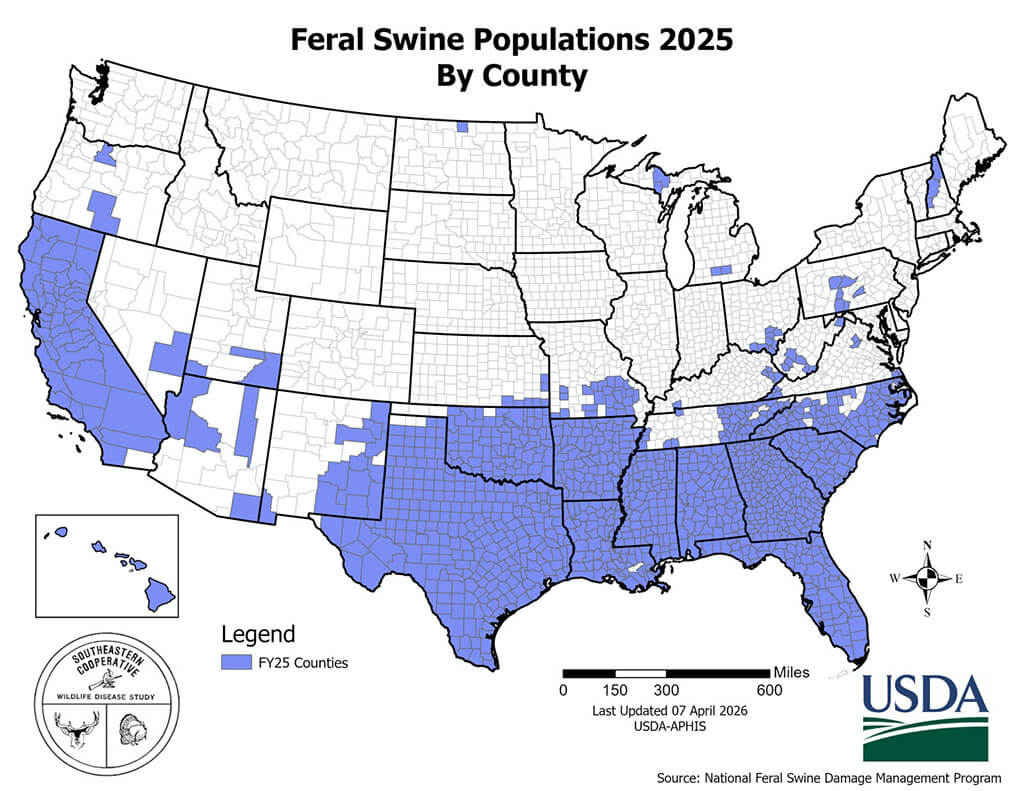
Good data on wild pig numbers are limited. Most states do not have a formal estimate of their wild pig population, or only a rough estimate based on numbers of pigs reported killed by hunters. But states with the largest populations, where wild pigs can be found statewide, are Texas, Florida, Georgia, California, Louisiana, Oklahoma and Hawaii.
It is difficult to predict if or when wild pigs will expand into new areas of the country. If the rate of past expansion continues, we could soon see wild pigs in most U.S. states (especially if pigs also move south from Canada). But there were unnatural reasons for the dramatic expansion of pigs’ range since the 1980s, and there may be natural barriers preventing wild pigs from becoming established in northern states. A lot depends on how successful states are at stopping the illegal transport and release of pigs.
Range expansion during wild pigs’ first 400 years in America was slow. A survey of land managers in 1977, for example, found that wild pig numbers were stable or decreasing in most southern states; only Texas reported an increasing population.42
There is agreement among scientists that the population growth and northward expansion of wild pigs in the U.S. during the last 40+ years did not happen naturally.
Pigs did not take advantage of a sudden increase in acorn availability, global warming, or other factors. Instead, “anthropogenic-assisted expansion,” to use a scientific term, was primarily responsible.2
Genetic studies have shown relationships between geographically separate populations of wild pigs, which would only be possible through movement by humans.43
It is not a coincidence that the spread of wild pigs took place as pig hunting grew in popularity.44 Wild pigs were intentionally transported and released by hunters in an effort to create new hunting opportunities, or to introduce new genes into an existing population, to “improve” the population. (Sometimes releases were unintended, when pigs escaped from fenced hunting preserves.) The Kentucky Department of Fish & Wildlife Resources describes the origin of pigs in the state bluntly, “Wild pigs arrived in Kentucky via pickup trucks.”3
Not too long ago, state wildlife agencies were also releasing or relocating wild pigs. The Florida Game and Fresh Water Fish Commission stocked wild pigs as recently as the 1960’s (management goals were, “increasing swine populations and improving genetics”).4 The Game Management Division of Wildlife Resources in West Virginia released European wild boars in 1971 to expand big-game hunting (boars are still hunted in the state).5
Are the wild pigs in the U.S. today descendants of historical or more recent introductions? To determine the origins of modern pigs, researchers from the National Park Service and the University of North Dakota analyzed mitochondrial DNA from pig tissue samples collected from throughout the United States. They found that wild pigs in the U.S. have inherited genetic material from “long-established populations.”6 The study also found that wild pigs in the U.S. are genetically diverse, which likely contributes to their ability to adapt to different environments and survive changes in the environment.
Other genetic studies have shown that wild pigs across the country are primarily hybrids of domestic pigs and European wild boar, which is surprising considering the limited numbers of known releases of wild boar. Scientists have suggested that pigs with wild boar genetic ancestry were better able to survive and reproduce than feral domestic pigs alone.7 Perhaps wild pigs would not have been as successful in the U.S. without wild boar’s genetic contributions?
Hunting
The wild pig is one of the most popular “big-game” animals in the U.S. In states where the hunting of wild pigs is legal, they may be hunted and trapped day and night, year-round and without limit on private land. A hunting license or permit may not even be required.
The lack of regulations makes it difficult to get good data on pigs killed by hunters. But in many states, wild pigs are second only to white-tailed deer in total number killed by hunters. (In Alabama, more pigs are killed by hunters than deer.)
Wild pigs have been called “the ‘poor man’s’ big game animal”,8 gaining popularity as the hunting of other animals became more expensive or unavailable. The ability to hunt pigs year round, to hunt using dogs, and to use methods not allowed in hunting other animals, has added to the popularity. Pig hunting videos on YouTube get millions of views.
Many states have a love-hate relationship with wild pigs. State agencies face the dilemma of what to do with animals disliked by farmers but valued by the hunting public.
Wild pig hunting has an enormous economic impact, which complicates management efforts. Although a license is often not required to hunt pigs, people travel to hunt pigs, pay fees to private landowners, and purchase numerous products specific to pig hunting: scents or attractants, protective collars and vests for dogs, dog first aid, etc. When making decisions about the management of wild pigs, many states likely include a cost-benefit analysis.
In the hunting of wild pigs, almost all weapons and methods are allowed: knives and spears, fully automatic guns, night hunting, the use of dogs, shooting from helicopters, and hunting over bait.
Hunters believe that castrating a young male pig will cause the pig to quickly gain weight and have better tasting, less gamey flesh. Castration is performed with the pig held down in the dirt, without anesthesia (pigs can die from the shock of the gruesome mutilation). The pig is then released, to be killed in a future hunt.
Pig hunts are brutal, terrifying events for the unfortunate animal.
“
… in the distance, a dog barks. Another minute passes. More barking. A hog squeals. The men take off, breaking into a short gallop for a half mile or so along an open trail. As they ride closer, the dogs rally, barking like mad. The hog’s cries are like a woman’s hysterical screams interspersed with deep guttural snorts and growls…. All ten dogs are mobbing the 80-pound sow, which lies motionless, though it continues to shriek and squeal. The dogs’ powerful jaws are clamped to every side of the hog, tearing at its limbs, ears and snout. They rip a hole in the sow’s stomach, unravel its long, slimy intestines and drag them through the dirt. The hog dies a few minutes later, but the dogs go on chewing at its flesh and playing with its innards.
– description of a hunt in south Texas, Houston Press, August 24, 20069
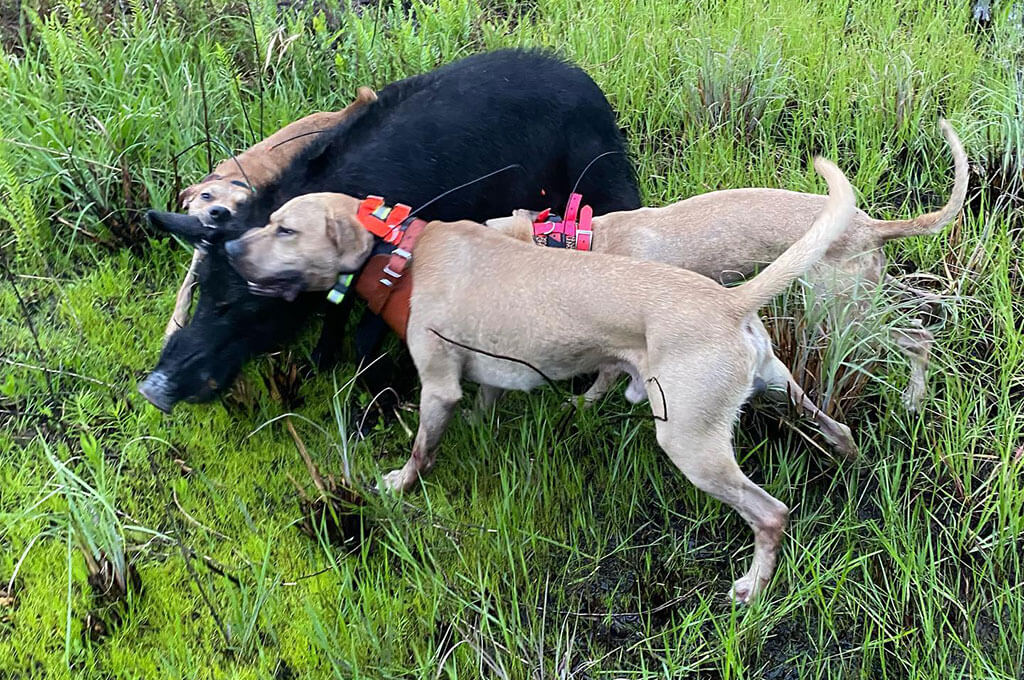
“Bay dogs” (sometimes wearing GPS radio collars) are trained to find, chase, and then bay (howl) for the hunter. Hunters commonly also use “catch dogs” that bite onto the pig’s ears and hold the exhausted pig until the hunter can kill the animal with a knife or other weapon. Before the dogs are restrained, the pig can suffer horrible injuries. Dogs can also be gored by the pig’s sharp tusks. If not killed, pigs may instead be hog-tied and sold for slaughter or relocated to a hunting preserve. Young pigs, or pigs whose teeth have been broken, are used in the training of hunting dogs. Why is this legal? Many state laws against animal fighting specifically exempt the use of dogs in hunting.
Cruelties like field castration, the use of primitive, inhumane weapons, and “catch dogs,” are not tolerated in the hunting of deer or turkeys or other animals. It is only because wild pigs are denigrated as disposable, nonnative animals that the most violent of actions are condoned.
Studies have found that pigs reproduce at a younger age in areas of high hunting pressure, a compensatory response similar to that found in coyotes and other heavily hunted animals.10,11
Hunting and trapping for profit
Hunting pigs inside fenced enclosures or on private hunting ranches is legal and common in many states. These ranches provide an economic incentive to maintain a large population of pigs. Supplemental feeding on ranches guarantee a healthy population. It’s big business! One guided pig hunt in California costs over $1,000 per day/animal killed.
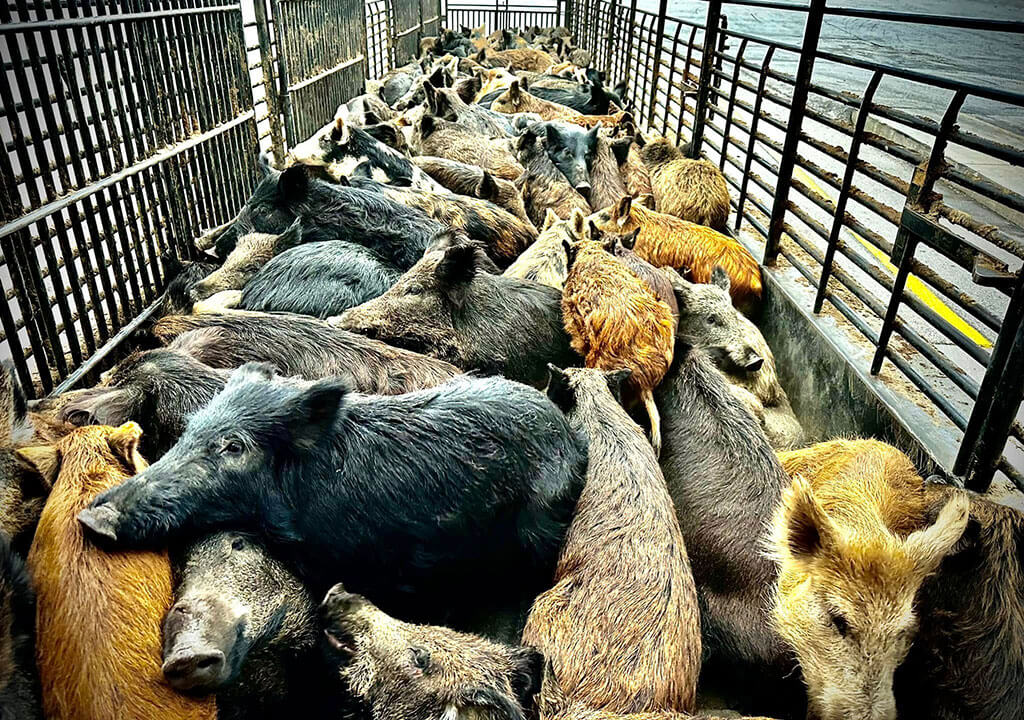
There are dozens of “Feral Swine Holding Facilities” in Florida and Texas12; these businesses purchase trapped pigs and hold them temporarily until a large number can be assembled for transport to a slaughterhouse or hunting ranch. A 2018 genetics study of wild pigs in Florida linked holding facilities to escapes or deliberate releases of pigs into new areas.41 (Researchers also shared anecdotal reports that thousands of wild pigs were released into a private hunting club in northern Florida in the early 2000s.)
Some hunting ranches promote their stock of “pure” European or Russian boar, despite the questionable origin of these animals.
Other states have banned such hunts. In Illinois and Wisconsin, it is illegal to hunt wild pigs in an enclosure.13 In Indiana, New Mexico, Oregon and Utah, it is illegal to sell hunts for wild pigs.14 Kansas has prohibited keeping pigs on fenced hunting preserves, and the killing of pigs for sport (“No person shall engage in, sponsor, instigate, assist or profit from the release, killing, wounding or attempted killing or wounding of feral swine for the purpose of sport, pleasure, amusement or production of a trophy.”)15
There is a moratorium on new captive hunting facilities for pigs in California and Missouri.16 In Michigan, after years of legal battles, the two ranches that still sell wild pig hunts have been ordered to eliminate their remaining pigs by 2026.17,18
Wild pigs are also targeted in killing contests,19 where participants compete for cash and prizes for killing the largest pig, or the pig with the longest tusks.
Wild pigs in a transport trailer owned by East Texas Slaughter & Packing (Laneville, TX)
Public perception
Public perception of wild pigs is often negative regardless of conflicts, large numbers of pigs, or even the actual presence of pigs. In a 2016 study, researchers surveyed people in Georgia, where pigs are well established statewide, and people in Illinois, where pigs are fairly new and present in small numbers in only 10% of the state’s counties.20 People in both states had similar negative attitudes about wild pigs. The researchers suggested that negative attitudes may be due to perceptions of wild pigs as “invasive,” “nonnative” species. The study referenced an earlier study of farmers in Mississippi that found 68% held negative attitudes toward wild pigs, “even though few respondents had experienced any damage.”21
The good news is that attitudes toward animals can change over time. For example, public opinion research has shown dramatic changes in attitudes (from negative to positive) toward predators like wolves and coyotes in the United States over the last few decades.22
Where wild pigs are valued as food, and/or where hunting is culturally important, people often have different views of the animals. Researchers from the Houston Advanced Research Center and Texas A&M University studied wild pigs in communities near the Big Thicket National Preserve in southeast Texas, where pigs were an important source of food for generations.23 When settlers arrived in the region in the 1800s, they brought pigs with them, likely joining pigs descended from those introduced by Spanish explorers. “Tending hogs in the woods” was common in these communities well into the 20th century, putting residents at odds with land managers. In interviews with residents, researchers found that residents contested the ideas that wild pigs are not native, that they are “out of place,” and that they had no ecological value (for example, residents held a belief that rooting by pigs was beneficial for oak trees). Because wild pigs had been present in the area for so long, the animals were seen as “part of nature.”
Wild pigs have become an important part of culture and traditions for the Seminole Tribe of Florida.24 In other parts of the United States and territories where wild pigs have been hunted for generations, like southern Appalachia, Hawaii and Guam, pigs are a valuable food source and have cultural importance.
Bias against pigs and other “nonnative” species is a problem in science.
“A narrow pursuit of evidence of ‘harm’, driven by invasion biologists, has blinkered researchers,” argues science writer Fred Pearce.25 Articles about wild pigs in scientific journals usually begin with a summary of potential negative effects, often citing the same mutually supporting studies. The focus is on the negative, even if the research didn’t show significant effects, or had conflicting results.
In a 2020 study, professor Stephen Hovick and students at Ohio State University examined over 200 papers about “biological invasions” and found that scientists often use misleading language when referring to introduced species.26 They concluded, “We found that invasion scientists use value-laden language that does not necessarily correspond with the actual magnitude of ecological impacts reported. In other words, negative language is used frequently, irrespective of a study’s reported effect size.”
In a 2011 paper titled, “How might science misdirect policy? Insights into the threats and consequences of invasive species,” conservation biologist Martin Schlaepfer27 argued that it is common in scientific studies about introduced species for “notions of change and harm” to be conflated. This is definitely true with research about wild pigs. In 2012, ecologists M. Noelia Barrios-Garcia and Sebastián Ballari28 published a review of research into wild pig impacts (their study may be the most widely cited about wild pigs). They noted that analysis of pig stomach contents has shown that pigs eat many different creatures, including insect larvae and earthworms, frogs and bird eggs, but they admitted that “little is known” about the effects of this predation on populations of these animals. So, is there harm?
Many wild animals create change in an environment, but when change is attributed to pigs, it usually leads to calls for lethal control.
Potential positive impacts of wild pigs in an ecosystem do not get attention from researchers.
Mountain lion chasing a wild pig in California’s Santa Cruz Mountains. Trail camera photo by John Ponce (March 2023).
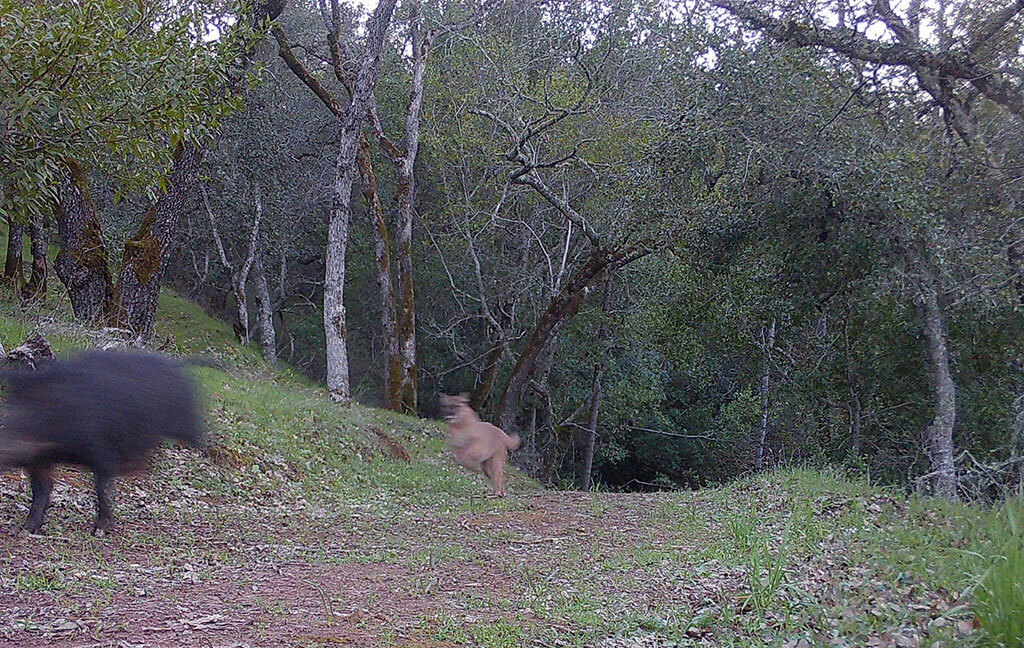
Potential positive impacts of wild pigs in an ecosystem do not get attention from researchers. For example, “nonnative” pigs serve as prey for “native” predators. In southwest Florida where wild pigs and the endangered Florida panther coexist, approximately 20% of a panther’s diet is comprised of wild pigs, according to state wildlife biologists.29 (However, by eating wild pigs, Florida panther may be exposed to pseudorabies virus which is common in pigs.30) If pig control efforts were successful and there were fewer pigs for panthers to eat, conflicts between panthers and livestock could increase.
Similarly, wild pigs are eaten by protected mountain lions in California (pigs may become an increasingly important food considering the state’s declining deer population), and wild pigs make up a significant portion of the diets of mountain lions in southern Texas.31
Cattle egrets at the Corkscrew Swamp Sanctuary (Naples, Florida) remove ticks and flies from wild pigs, and eat insects stirred up by pigs walking through vegetation. Trail camera photo by Audubon Florida (February 2023).
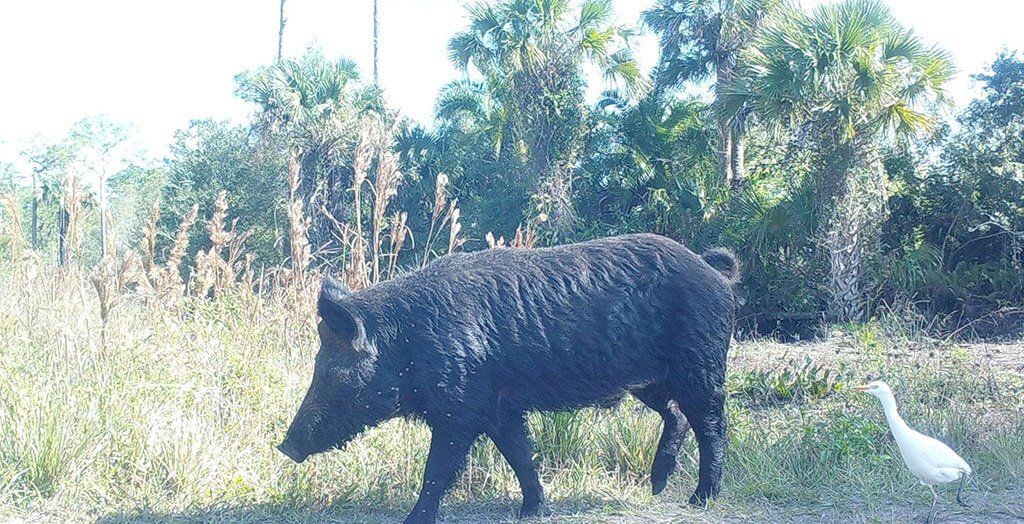
Several studies have reported symbiotic relationships between birds and wild pigs. For example, the threatened Florida scrub jay as well as the common crow have been observed eating ticks or insects off the backs of wild pigs.28
In Florida, the Cypress Chapter of the Izaak Walton League of America, in collaboration with the Miccosukee Tribe, is working to increase numbers of white-tailed deer in the Everglades region.32 Their efforts have included supporting a “healthy” wild pig population that they hope will act as “alternative prey” for Burmese pythons and other predators, thereby improving deer survival.
Wild pigs may serve as “functional substitutes” for animals no longer present in an ecosystem. Grizzly bears once roamed California’s oak woodlands where they ate large quantities of acorns and dug into the soil in search of roots and other foods. By the turn of the 20th century, grizzlies had been largely exterminated by settlers. There is some evidence that wild pigs perform the same ecological function as the extinct grizzly bear.33 Acorn foraging and soil disturbance by wild pigs may be important in oak woodland ecosystems: when soil is disturbed, space is created, promoting the growth of some plants, and enhancing biodiversity.
“
One possibility is that pig disturbances may facilitate the invasion of exotic plant species. Alternatively, pigs may substitute for a lost disturbance agent, clear space in the landscape, interrupt the competitive dominance of exotic species, and thereby create refugia in which native plants can flourish.
– J. Hall Cushman, Trisha A. Tierney and Jean M. Hinds, “Variable Effects of Feral Pig Disturbances on Native and Exotic Plants in a California Grassland” (Ecological Applications, December 2004)34
Rooting by wild pigs may substitute for natural events that benefit habitats, such as wildfires, which have long been suppressed by governments.35 Early successional plants (“those that first began to grow in an area following a disturbance,” as defined by the USDA) often appear at sites rooted by pigs; these grasses, shrubs and other plants provide important food and habitat for wildlife.36
Pigs may also play an important role for plant species that rely on animals to disperse their seeds. Studies conducted outside of North America have shown that wild pigs are effective seed dispersers.37,38 Seeds are eaten, or get stuck between pig hooves or attached to their hair, and can be spread miles away.
Hog-dog rodeos
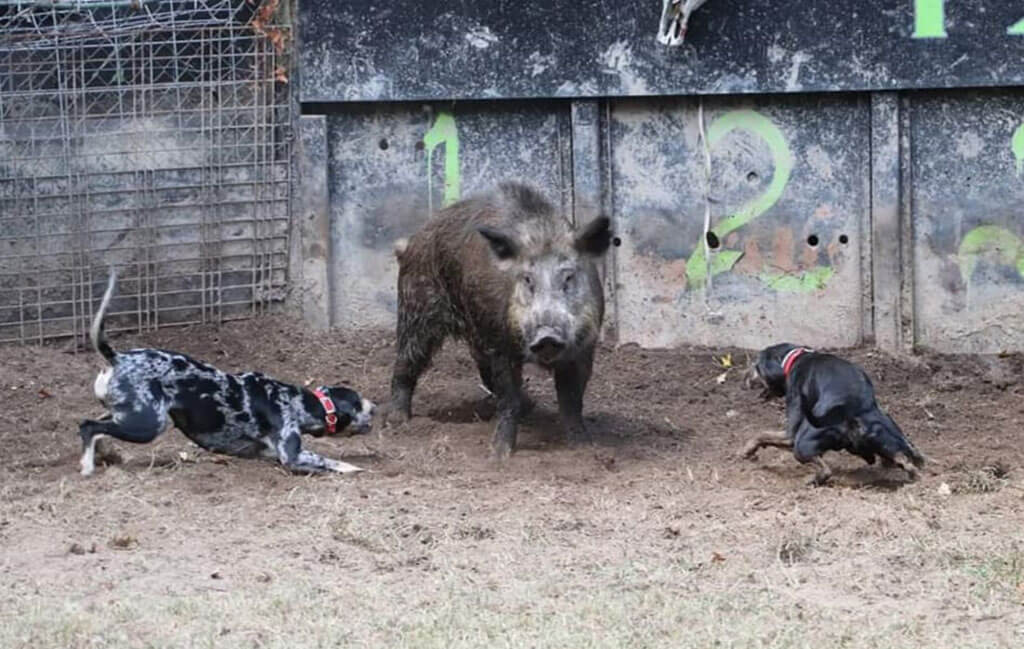
So-called “hog baying” events or “hog dog trials,” and “hog-catch trials,” are related events with a blurry line between legal and illegal activity.
Baying events are regularly held in several states including Georgia, Louisiana and Texas.
During the events, a pig is released into a small, fenced arena and then one or more dogs attempt to control or “bay” the pig and stop the animal from running away.
Although dogs in baying events are penalized for biting the pig, it is common for trapped pigs to be bitten. The events are terrifying for pigs. Dogs can also be injured by pigs defending themselves.
In contrast, in hog-catching events, dogs (often pit bull type dogs) are encouraged to attack a pig in a pen. Pig’s tusks are crudely cut or broken to leave them defenseless. The dog that pulls the pig to the ground the fastest wins. Pigs suffer ripped ears, torn noses and horrible injuries during these bloody events.
Most states in the southern U.S. have outlawed hog-catch events: Alabama, Louisiana, Mississippi, North Carolina, South Carolina, and Tennessee.39 State attorneys in Florida and Texas have stated that these events violate the state’s animal fighting law.40 Georgia are Oklahoma are exceptions, without laws on the books that clearly make hog-catch events illegal.
State laws split hairs by prohibiting events, “in which it is intended or reasonably foreseeable that the canines or hogs would be injured, maimed, mutilated, or killed” (identical language from laws in Louisiana and Mississippi). But the laws specifically exclude events, “in which competitive points are deducted if a hog is caught and held,” as well as hunting of pigs with dogs.
REFERENCES
1. Animal and Plant Health Inspection System, U.S. Department of Agriculture. https://www.aphis.usda.gov/operational-wildlife-activities/feral-swine/distribution
2. Snow, N.P., Jarzyna, M.A. & VerCauteren, K.C. (2017). Interpreting and predicting the spread of invasive wild pigs. Journal of Applied Ecology, 54, 2022-2032. https://doi.org/10.1111/1365-2664.12866
3. Kentucky Department of Fish & Wildlife Resources. https://fw.ky.gov/InvasiveSpecies/Pages/Wild-Pig-Home.aspx
4. Natural Resources 1965. The proving ground for conservation. Fish and Wildlife Conservation Program. Eglin Air Force Base, Florida. As cited in Engeman, R., Stevens, A., Allen, J. et al. (2007). Feral swine management for conservation of an imperiled wetland habitat: Florida’s vanishing seepage slopes. Biological Conservation, 134, 440-446. https://doi:10.1016/j.biocon.2006.08.033
5. West Virginia Division of Natural Resources. https://wvdnr.gov/plants-animals/big-game/
6. Mccann, B.E., Malek, M., Newman, R. et al. (2014). Mitochondrial Diversity Supports Multiple Origins for Invasive Pigs. The Journal of Wildlife Management, 78(2) 202–213. https://doi.org/10.1002/jwmg.651
7. Barmentlo, N.W.G., Meirmans, P.G., Stiver, W.H. et al. (2024). Natural selection on feralization genes contributed to the invasive spread of wild pigs throughout the United States. Molecular Ecology, 33(12). https://doi:10.1111/mec.17383
8. Tolleson, D.R., Pinchak, W.E., Rollins, D. et al. (1995). Feral Hogs In The Rolling Plains of Texas: Perspectives, Problems, and Potential. Great Plains Wildlife Damage Control Workshop Proceedings, 124-128. https://digitalcommons.unl.edu/gpwdcwp/454
9. Spivak, T. (2006, August 24) Hog Wild. Houston Press. https://www.houstonpress.com/news/hog-wild-6574449/
10. Gamelon, M., Besnard, A., Gaillard, J.M. et al. (2011). High hunting pressure selects for earlier birth date: wild boar as a case study. Evolution, 65(11), 3100-12. https://doi.org/10.1111/j.1558-5646.2011.01366.x
11. Servanty, S., Gaillard, J.M., Toïgo, C. et al. (2009). Pulsed resources and climate-induced variation in the reproductive traits of wild boar under high hunting pressure. Journal of Animal Ecology, 78(6), 1278-1290. https://doi.org/10.1111/j.1365-2656.2009.01579.x
12. Texas Animal Health Commission (2025, November 14). https://www.tahc.texas.gov/animal_health/swine/pdf/FeralSwineFacilities.pdf
13.
Wild Swine. Illinois Administrative Code § 700.30 (2014) https://dnr.illinois.gov/content/dam/soi/en/web/dnr/adrules/documents/17-700.pdf
Harmful wild animals. Wisconsin Statutes § 169.11 (2007) https://docs.legis.wisconsin.gov/statutes/statutes/169/11
14.
Wild pigs. Indiana Administrative Code § 9-3-18.6 (2010) https://iar.iga.in.gov/code/2026/312/9#312-9-3-18.6
Feral hogs; prohibition; penalty. New Mexico Statutes § 77-18-6 (2024) https://law.justia.com/codes/new-mexico/chapter-77/article-18/section-77-18-6/
Privately Held Exotic and Game Mammals. Oregon Administrative Rules § 635-064-0010 (2009) https://secure.sos.state.or.us/oard/viewSingleRule.action?ruleVrsnRsn=170748
Feral swine detrimental to state’s interests — Seizure, capture, or destruction of feral swine. Utah Code. § 4-25-303 (2025) https://le.utah.gov/xcode/Title4/Chapter25/4-25-S303.html
15. Feral swine; prohibited acts related to such swine. Kansas Statutes. § 47-1809 (2012) https://ksrevisor.gov/statutes/chapters/ch47/047_018_0009.html
16.
Wild Pigs. California Fish and Game Code § 4652.5 (2024) https://leginfo.legislature.ca.gov/faces/codes_displayText.xhtml?lawCode=FGC&division=4.&title=&part=3.&chapter=7.&article=
Licensed Hunting Preserve Permit. Missouri Wildlife Code § 3 CSR 10-9.560 (2025) https://www.sos.mo.gov/CMSImages/AdRules/csr/current/3csr/3c10-9.pdf
17. Invasive Species Order. Michigan Department of Natural Resources (2010) https://www.michigan.gov/invasives/-/media/Project/Websites/invasives/Documents/Laws/ISO_Amendment-1_2014.pdf
18. LeBlanc, Beth. (2025, July 29) Judge orders U.P. hunting locations to kill off their feral pigs within a year. The Detroit News. https://www.detroitnews.com/story/news/politics/2025/07/29/judge-gives-u-p-hunting-locations-a-year-to-kill-off-their-feral-pigs/85430669007/
19. National Coalition to End Wildlife Killing Contests. Help Ban Wildlife Killing Contests. https://bankillingcontests.org/
20. Harper, E.E., Miller, C.A., Vaske, J.J. et al. (2016). Stakeholder attitudes and beliefs toward wild pigs in Georgia and Illinois. Wildlife Society Bulletin, 40, 269-273.https://doi.org/10.1002/wsb.653
21. Fogarty, E. P. (2007). National distribution of feral hogs and related stakeholder attitudes [Doctoral dissertation, Mississippi State University].
22. George, K., Slagle, K., Wilson, R. et al. (2016). Changes in attitudes toward animals in the United States from 1978 to 2014. Biological Conservation, 201, 237-242. https://doi.org/10.1016/j.biocon.2016.07.013
23. Weeks, P., & Packard, J. (2009). Feral Hogs: Invasive Species or Nature’s Bounty? Human Organization, 68(3), 280–292. https://doi.org/10.17730/humo.68.3.663wn82g164321u1
24. U.S. Department of Agriculture, Animal and Plant Health Inspection Service. (2015). Final Environmental Impact Statement: Feral Swine Damage Management: A National Approach. https://www.aphis.usda.gov/sites/default/files/us-2015-fs-damage-mgt-a-national-approach-eis.pdf
25. Pearce, F. (2015). The New Wild: Why Invasive Species Will Be Nature’s Salvation. Beacon Press.
26. Mattingly, K., Pelletier, T., Lanterman, J. et al. (2020). Disconnects between Communicated Impact and Ecological Impact of Biological Invasions. BioScience, 70(3), 252–263. https://doi.org/10.1093/biosci/biaa003
27. Schlaepfer, M.A., Pascal, M. & Davis, M.A. (2011). How might science misdirect policy? Insights into the threats and consequences of invasive species. Journal of Consumer Protections and Food Policy, 6(1), 27–31. https://doi.org/10.1007/s00003-011-0690-7
28. Barrios-Garcia, M.N., & Ballari, S.A. (2012). Impact of wild boar (Sus scrofa) in its introduced and native range: a review. Biological Invasions, 14, 2283–2300. https://doi.org/10.1007/s10530-012-0229-6
29. Florida Fish and Wildlife Conservation Commission. Panther Biology: Diet. https://myfwc.com/wildlifehabitats/wildlife/panther/biology/
30. Glass, C.M., McLean, R.G., Katz, J.B., et al. (1994). Isolation of pseudorabies (Aujeszky’s disease) virus from a Florida panther. Journal of Wildlife Diseases, 30(2), 180-184. https://doi:10.7589/0090-3558-30.2.180
31. Harveson, L. A., Tewes, M. E., Silvy, N. J., et al. (2000). Prey Use by Mountain Lions in Southern Texas. The Southwestern Naturalist, 45(4), 472–476. https://doi.org/10.2307/3672595
32. Cypress Chapter of the Izaak Walton League of America. Bringing Deer Back Home – A Program to Restore Balance. https://cypressiwla.org/deerfriends/
33. Sweitzer, R.A. & Van Vuren, D.H. (2001). Rooting and Foraging Effects of Wild Pigs on Tree Regeneration and Acorn Survival in California’s Oak Woodland Ecosystems. In Proceedings of the Fifth Symposium on Oak Woodlands: Oaks in California’s Changing Landscape (General Technical Report PSW-GTR-184). United States Department of Agriculture.
34. Cushman, J., Tierney, T. & Hinds, J. (2004). Variable effects of feral pig disturbances on native and exotic plants in a California grassland. Ecological Applications, 14(6), 1746-1756. https://doi.org/10.1890/03-5142
35. Kotanen, P.M. (1995), Responses of vegetation to a changing regime of disturbance: effects of feral pigs in a Californian coastal prairie. Ecography, 18(2), 190-199. https://doi.org/10.1111/j.1600-0587.1995.tb00340.x
36. Everitt, J.H., & Alaniz, M.A. (1980). Fall and winter diets of feral pigs in south Texas. Journal of Range Management, 33(2), 126-129. https://doi.org/10.2307/3898426
37. Pedrosa, F., Berce, W., Levi, T., et al. (2019). Seed dispersal effectiveness by a large-bodied invasive species in defaunated landscapes. Biotropica, 51(6), 862–873. https://doi.org/10.1111/btp.12706
38. Dovrat, G., Perevolotsky, A. & Ne’eman, G. (2012). Wild boars as seed dispersal agents of exotic plants from agricultural lands to conservation areas. Journal of Arid Environments, 78, 49-54. https://doi.org/10.1016/j.jaridenv.2011.11.011
39.
Hog and Canine Fighting. Alabama Criminal Code § 13A-12-6 (2024) https://law.justia.com/codes/alabama/title-13a/chapter-12/article-1/section-13a-12-6/
Hog and canine fighting prohibited. Louisiana Revised Statutes § 14:102.19 (2024) https://legis.la.gov/Legis/Law.aspx?d=285167
Prohibition against intentionally conducting fight between canine and hog. Mississippi Code § 97-41-18 (2024) https://law.justia.com/codes/mississippi/title-97/chapter-41/section-97-41-18/
Dog fighting and baiting. North Carolina Code § 14‑362.2 (2005) https://www.ncleg.net/enactedlegislation/statutes/html/bysection/chapter_14/gs_14-362.2.html
Applicability of chapter to hunting dogs and certain events. South Carolina Code § 16-27-80 (2024) https://www.scstatehouse.gov/code/t16c027.php
Cock and animal fighting. Tennessee Code § 39-14-203 (2024) https://law.justia.com/codes/tennessee/title-39/chapter-14/part-2/section-39-14-203/
40.
Florida Attorney General Opinion No. AGO 94-43 (1994, May 5) https://www.myfloridalegal.com/ag-opinions/hog-dog-field-trial-violates-animal-fighting-act
Texas Attorney General Opinion No. 94-071 (1994, September 21) https://www.animallaw.info/case/texas-attorney-general-letter-opinion-94-071
41. Hernández, F.A., Parker, B.M., Pylant, C.L. et al. (2018) Invasion ecology of wild pigs (Sus scrofa) in Florida, USA: the role of humans in the expansion and colonization of an invasive wild ungulate. Biological Invasions, 20, 1865–1880. https://doi.org/10.1007/s10530-018-1667-6
42. Wood, G.W. & Lynn, T.E. (1977). Wild Hogs in Southern Forests. Southern Journal of Applied Forestry, 1(2), 12–17. https://doi.org/10.1093/sjaf/1.2.12
43. Smith, A.L. (2019). Wild Pig Policy and Legislation. In VerCauteren, K.C., Beasley, J.C., Ditchkoff, S.S., Mayer, J.J., Roloff, G.J., & Strickland, B.K. (Eds.), Invasive Wild Pigs in North America: Ecology, Impacts, and Management (pp. 199-227). CRC Press. https://doi.org/10.1201/b22014
44. Beasley, J.C., Lavelle, M.J., Keiter, D.A. et al. (2019). Research Methods for Wild Pigs. In VerCauteren, K.C., Beasley, J.C., Ditchkoff, S.S., Mayer, J.J., Roloff, G.J., & Strickland, B.K. (Eds.), Invasive Wild Pigs in North America: Ecology, Impacts, and Management (pp. 245-273). CRC Press. https://doi.org/10.1201/b22014