
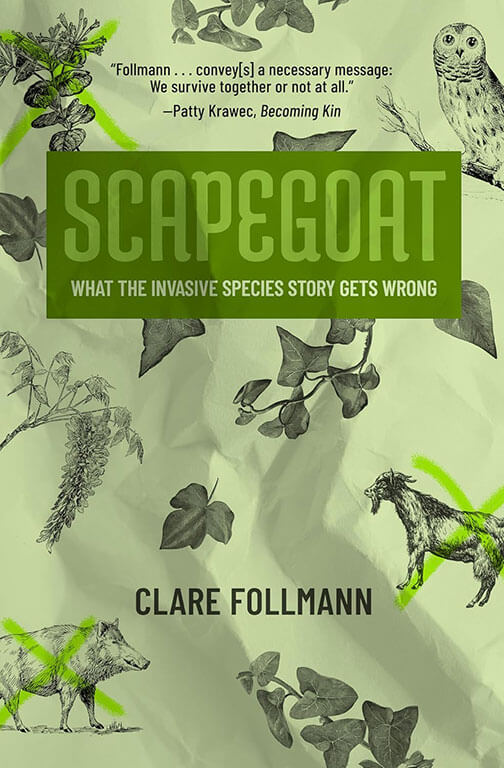
Scapegoat is a new book by Clare Follman (available from AK Press). As the title suggests, Follman believes that the focus on invasive species is a distraction from bigger threats to global biodiversity, such as habitat destruction, pollution, and climate change. For Follman, the true villain is global capitalism. “Our environmental crisis isn’t driven by invasive species,” she writes. “It is driven by capitalism.”
Follman is a student of language, and a critique of the misleading language used when talking about invasive species– by scientists, popular media, and policymakers– is an important part of Scapegoat. She writes, “The term ‘invasive,’ with its specious yet compelling militaristic undertones, is a form of sophistic rhetoric that can easily shut down alternate perspectives.”
The native/nonnative dichotomy is criticized as an oversimplification. Follman pushes back against the traditional idea of ecosystems as a collection of species who belong there, and instead promotes a “relational perspective.” Nature is constantly changing, with new relationships forming between species. A species (even wild pigs, we would argue!) is not “innately invasive.” Instead, Follman writes, “Determining whether or not a species is disruptive in a given, discrete area requires studying the relationships among the species present in the area.”
Follman’s frustration with “invasive species management” and mainstream science is clear, but Scapegoat is also hopeful. The second half of the short, 150-page book is a search for solutions. Follman provides examples of people around the world who are fighting to protect the planet while envisioning a post-capitalist world.
Scapegoat is an important addition to the debate over “invasive species.”