
Rooting for Pigs
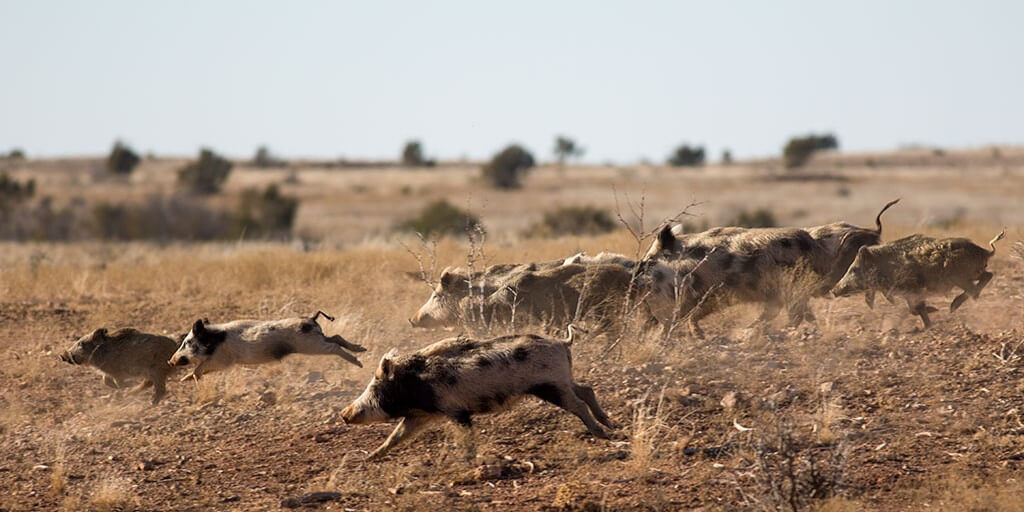
photograph by Wyman Meinzer
Wild pigs are intelligent, adaptable animals who thrive in a wide variety of habitats. They are found in the swamps of Alabama, in woods and grasslands in California, from Florida’s Everglades to its panhandle, in tropical forests in Hawaii, dense rhododendron thickets in Tennessee, in the hills of West Virginia, and across the state of Texas.
The history of the wild pig in the U.S. is a story of many introductions (or reintroductions), over hundreds of years, from foreign lands and between states. It’s a story of countless escapes from captivity, and intentional releases.
This website is part scientific literature review, part appreciation, and part plea.
We hope to inspire people to learn about pigs, how they are unique, and how they are similar to humans and other animals.
The more we learn, the less likely we are to accept crude characterizations, and instead see the complexity of these animals.
We want to change how people see wild pigs. We also hope to create a healthy skepticism about what is said about wild pigs, in the media, by conservationists, and others.
Our message may be challenging to consider. Compassion for wild pigs contradicts widely held beliefs. By questioning assumptions, and countering misinformation about pigs, we can encourage more positive views and behaviors.
Wild Pigs Today
Wild pigs are also called wild hogs, feral swine, razorbacks or piney woods rooters. Sus scrofa is their scientific name (“Sus” is Latin for “pig”). Curiously, Louisiana’s state wildlife agency refers to them as “outlaw quadrupeds.”1 In Arkansas, any domestic pig that has escaped confinement is considered a “feral hog” after 5 days on the loose.2
The most loaded official definition may be found in the New Mexico Administrative Code: “Feral hogs are considered vermin, incompatible with the environment, and are noxious, pestilent, predatory, foreign and invasive, offensive and injurious to man and his domesticated animals, and … are not protected against removal, destruction or elimination.”3
On this website, we use the term “wild pigs” to refer to all free-living pigs in the United States, including descendants of domesticated pigs who were released or escaped confinement hundreds of years ago, as well as descendants of European wild boar introduced into the country in more recent history, and hybrids between the two. We try to avoid using the terms “nonnative” or “exotic” or “invasive”, terms that can be harmful, and are often inaccurate. We sometimes simply say “pigs” when talking about behavior and biology. There is little difference in natural behaviors between wild pigs and domestic pigs in captivity (we wonder, at what point does a pig lose its domesticity and become “wild”?).
Wild pigs are rarely mentioned in popular media without the use of words like “destructive” or “invaders”. Their impact is dramatized. The Los Angeles Times in 2024 described them as “biological time bombs.”4 Wild pigs are commonly described as disease-ridden animals, who eat anything, and multiply like rabbits. Environmental historian Alfred W. Crosby described pigs as the “weediest” of all introduced animals.5 Wild pigs are on the World Conservation Union’s list of world’s worst “invasive alien species.” And according to the U.S. Department of Agriculture, wild pigs are a “harmful and destructive invasive species” that “negatively impacts everything from agriculture and the environment to human health and public safety.”6
Is all this fearmongering justified? Do the apocalypse predictions stand up to scrutiny? Is it OK to like wild pigs?
Why we're rooting for pigs!
Wild pigs are not worthless, ugly, or unnatural. But they are in need of a makeover in public opinion and scientific consideration.
Wild pigs are native to the United States
A challenging idea, perhaps? How animals are categorized has consequences. The root of the hostility toward wild pigs is their “nonnative” status. The bias against nonnative or introduced species has been widely accepted: Native species are to be protected; nonnative species are to be exterminated. According to ecologist Mark Davis,8 once a species is defined as nonnative, every impact, even the trivial, is considered harm and obligates “society to spend resources to fix ‘the problem.’”
The term itself carries stigma and works to increase the public’s tolerance for cruelty. As nonnative animals, the mass killing of pigs, and even practices that involve extreme animal suffering (like the use of spears and other primitive hunting weapons, or castration without anesthesia) is considered acceptable or even necessary.9 Their suffering can be disregarded. Environmental philosopher Thom van Dooren10 wrote that simplistic notions about nonnative species (native=good, nonnative=bad) provide justification, “a sense of moral comfort” about killing those who don’t “belong.”
For their detractors, the fact that wild pigs have inhabited North America for close to 500 years is not significant. The only important fact seems to be that pigs were introduced to the land by humans.
For thousands of years, humans have moved plants and animals (and insects and germs) around the world.11 Beginning in the early 1500s, pigs were transported globally by European explorers and colonists. In the United States, the spread of pigs mirrored the movement of European settlers across the country.
Pigs’ success in expanding around the country would never have been possible without human help. The movement and release of pigs for sport hunting (and especially hunting with dogs) is believed to be the driving force behind the expansion of wild pigs’ range in the U.S. in the 20th century.
We hope to encourage a reconsideration of wild pigs’ status in the U.S. Our goal is recognition of wild pigs as native, at least in their “historic” range (Texas, California, Florida, and other southern states), or perhaps recategorization as a “long-established” or “naturalized” species?
We live in a country where nonnative organisms are declared state symbols (e.g., the ring-necked pheasant in South Dakota), where nonnative birds and fish are introduced by the thousands by game agencies into the natural environment, where millions of acres of farm fields are planted with nonnative plants. Pigs live amongst many other introduced/nonnative plants and animals in “‘melting pot’ landscapes,” to use a term coined by geographer Christian Kull.12
Nonnative status should not be permanent. As journalist and bestselling author Michael Pollan asked (when writing about nonnative plants), “Shouldn’t there be a statute of limitations on their alien status?”13 Thankfully, more people are rethinking the strict native/nonnative dichotomy.
Wild pigs are free-living animals who have been present in North America (not including Hawaii) for almost 500 years. We can debate how many years must pass before an introduced species can be considered native or naturalized, but we believe that time has come for wild pigs! Wild pigs in large parts of the U.S. cannot reasonably be considered new members of the ecosystem.
Wild pigs are amazing and important
It’s OK to like wild pigs and to celebrate their wildness. Wild pigs deserve our wonder and respect, in the same way we view other wild animals. Pigs, like all animals, have value as part of nature, as members of a species, and as individuals. Wild pigs desire to live freely.
They are animals of historical and cultural importance. And, although some people may not like it, pigs are now thoroughly part of landscapes across the country. Wild pigs are here to stay.
Pigs are survivors, a symbol of nature’s resilience. They have escaped domestication and returned to wildness.
Ethical coexistence is possible
How do we live with pigs?
We do not disagree with efforts to keep potentially harmful species out of the country. It makes sense to prevent the establishment of pigs in new areas, and to protect particularly sensitive ecosystems and valuable man-made sites, but in parts of the country where pigs have large, established populations, eradication is most likely impossible.
More research and funding are needed to develop effective non-lethal methods of addressing pig conflicts. For example, researchers in Europe are exploring whether the use of oral contraceptives could work to reduce wild pig numbers.14
Humane wildlife management is difficult work; unfortunately, the default when there is a pig problem is to start killing, even if it’s unlikely that the control efforts will be successful.
When the options are endless killing or coexistence, the choice should be the latter.
“
An abundance of scientific research demonstrates that pigs are similar in many ways to humans. They have personalities and emotions. They can understand time and play creatively. But they are also intriguingly different.
– Thinking Pigs: Cognition, Emotion, And Personality, by Lori Marino, Christina M. Colvin, and Lauri Torgerson-White (The Someone Project)7
When pigs eat, wallow or explore, they can cause problems for farmers, land managers, and homeowners. Pigs have negative impacts in some ecosystems, although many of the claims of ecological harm do not withstand close examination.
Damage to agricultural crops or a manicured lawn is easy to identify and measure, but “ecological harm is in the eye of the beholder,” explains Mark Davis,15 an ecologist who has written numerous papers on introduced species and the textbook, Invasion Biology. In a 2019 paper Davis asked, would the ecological “harm” that introduced species are blamed for be better described as change? If the presence of wild pigs is shown to lead to decreased numbers of freshwater mussels in a Louisiana watershed, for example, that is change that may not rise to the level of harm. The simple presence of a new species in an environment should not automatically be considered harm.16
In 2022, researchers from Auburn University and the USDA’s National Wildlife Research Center published what they described as a “comprehensive review” of the impacts of wild pigs.17 They concluded that wild pigs are a threat to “native” animals, but then equivocated: “Unfortunately, much of the information regarding these threats is surface level or anecdotal. There is a lack of research depicting the degree to which these impacts occur. For example, we know that wild pigs predate sea turtle nests but we do not have a firm grasp of the degree to which they impact populations.”
Pigs can change natural areas. But pigs, like many wild animals, have both negative and positive (and neutral) ecological impacts.
To some extent, every wild animal competes with others for resources, or is susceptible to disease, or harms the natural environment.
Conflicts between humans and animals, native and nonnative, are inevitable. The challenge is to find a way to live together.
REFERENCES
1. Definitions. Louisiana Revised Statutes § 56:8 (2022) https://legis.la.gov/Legis/law.aspx?d=105616
2. Feral Hogs. Arkansas Code Ann. § 2-38-501 (2021)
https://advance.lexis.com/api/document/collection/statutes-legislation/id/5W31-53P0-R03K-313X-00008-00?cite=A.C.A.%20%C2%A7%202-38-501&context=1000516
3. Feral Hogs. New Mexico Admin. Code § 21.30.9.8 NMAC (2012)
https://prod-rf-lambda.rtssaas.com/PublicFiles/d89c47bd0d70402dba89b03a22bda6d1/4ba3e4f5-4b02-4bc9-844b-66d402fa37d4/21.030.0009.html
4. Rust, S (2022, April 1). Feral pigs are biological time bombs. Can California stem their ‘exponential’ damage? Los Angeles Times. https://www.latimes.com/california/story/2022-04-01/feral-pigs-ravage-california-wildlands-suburbs-hunting
5. Crosby, A. (1986). Ecological Imperialism: The Biological Expansion of Europe, 900-1900 (2nd ed.). Cambridge University Press. https://doi.org/10.1017/CBO9780511805554
6. U.S. Department of Agriculture (2020). Feral Swine: Damages, Disease Threats, and Other Risks (USDA/APHIS, Program Aid No. 2195b). https://www.aphis.usda.gov/sites/default/files/fsc-feral-swine-risks.pdf
7. Marino, L., Colvin, C. & Torgerson-White, L. Thinking Pigs: Cognition, Emotion, and Personality. Kimmela Center for Animal Advocacy, and Farm Sanctuary. https://assets.farmsanctuary.org/content/uploads/2021/12/14130857/pig-white-paperV4.pdf
8. Davis, M.A. (2013). Invasive Plants and Animal Species: Threats to Ecosystem Services. In R. Pielke, (Ed.), Climate Vulnerability (pp. 51-59). Academic Press. https://doi.org/10.1016/B978-0-12-384703-4.00405-6.
9. Wallach A.D., Bekoff M., Batavia C. et al. (2018). Summoning compassion to address the challenges of conservation. Conservation Biology, 32(6), 1255-1265. https://doi.org/10.1111/cobi.13126
10. van Dooren, T. (2011). Invasive Species in Penguin Worlds: An Ethical Taxonomy of Killing for Conservation. Conservation and Society, 9(4), 286–298. http://www.jstor.org/stable/26393053
11. Sagoff, M. (2002). What’s Wrong with Exotic Species?. In W. Galston (Ed.), Philosophical Dimensions of Public Policy (pp. 327-340). Routledge. https://10.4324/9781315126357-34
12. Kull, C. A., Carrière, S. M., Moreau, S. et al.(2013). Melting Pots of Biodiversity: Tropical Smallholder Farm Landscapes as Guarantors of Sustainability. Environment: Science and Policy for Sustainable Development, 55(2), 6–16. https://doi.org/10.1080/00139157.2013.765307
13. Pollan, M. (1994, May 15) Against Nativism. New York Times Magazine, (6), 52.
14. Botstiber Institute for Wildlife Fertility Control. Retrieved January 3, 2026, from https://wildlifefertilitycontrol.org/
15. Davis, M. (2019). Defining nature: Competing perspectives: between nativism and ecological novelty. Metode Science Studies Journal, (9), 101–107. https://doi.org/10.7203/metode.9.10878
16. Schlaepfer, M.A., Pascal, M. & Davis, M.A. (2011). How might science misdirect policy? Insights into the threats and consequences of invasive species. Journal of Consumer Protections and Food Policy, 6 (1), 27–31. https://doi.org/10.1007/s00003-011-0690-7
17. McDonough, M.T., Ditchkoff, S.S., Smith, M.D. et al. (2022). A review of the impacts of invasive wild pigs on native vertebrates. Mammalian Biology, 102, 279–290. https://doi.org/10.1007/s42991-022-00234-6